There is a particular kind of warmth that only comes from a bubbling pot placed in the center of a table. In Korea, that pot is almost always a jjigae — a hearty, deeply seasoned stew that arrives still boiling, steam rising, the broth a deep amber or crimson depending on what's inside. And more often than not, there are no individual bowls waiting on the side. You simply dip your spoon in, and so does everyone else.
This is not a quirk. It is a philosophy.
ㅤㅤㅤㅤㅤㅤㅤㅤ
What Is Jjigae, Exactly?
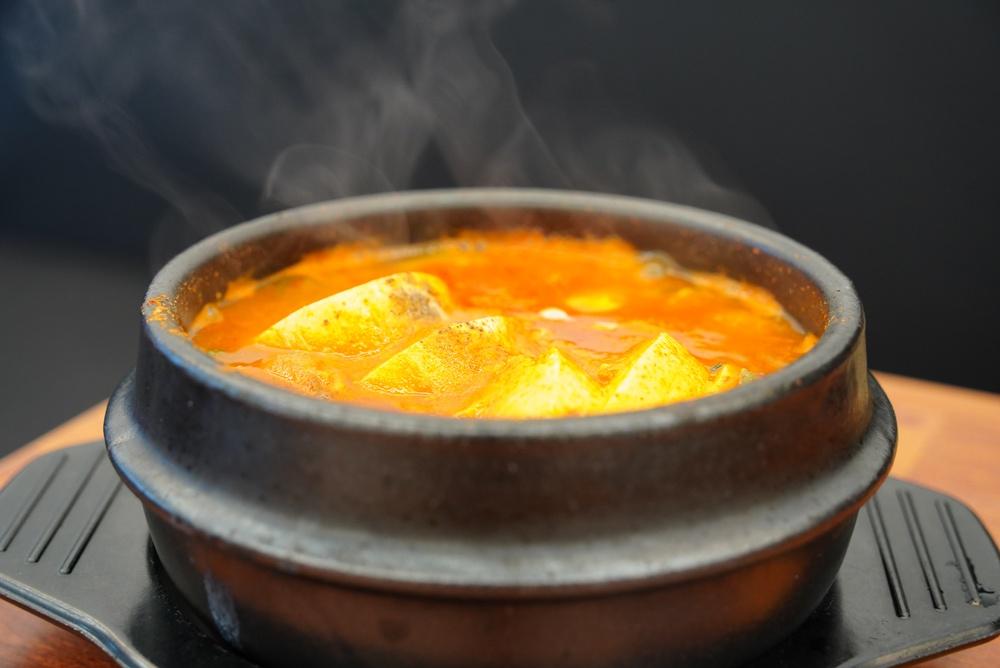
Jjigae (찌개) is a category of Korean stew, distinct from guk (soup) by its thicker consistency and bolder seasoning. It is usually made with a fermented base — doenjang (된장, fermented soybean paste), gochujang (고추장, red chili paste), or kimchi — and filled with tofu, vegetables, mushrooms, pork, seafood, or a combination of these.
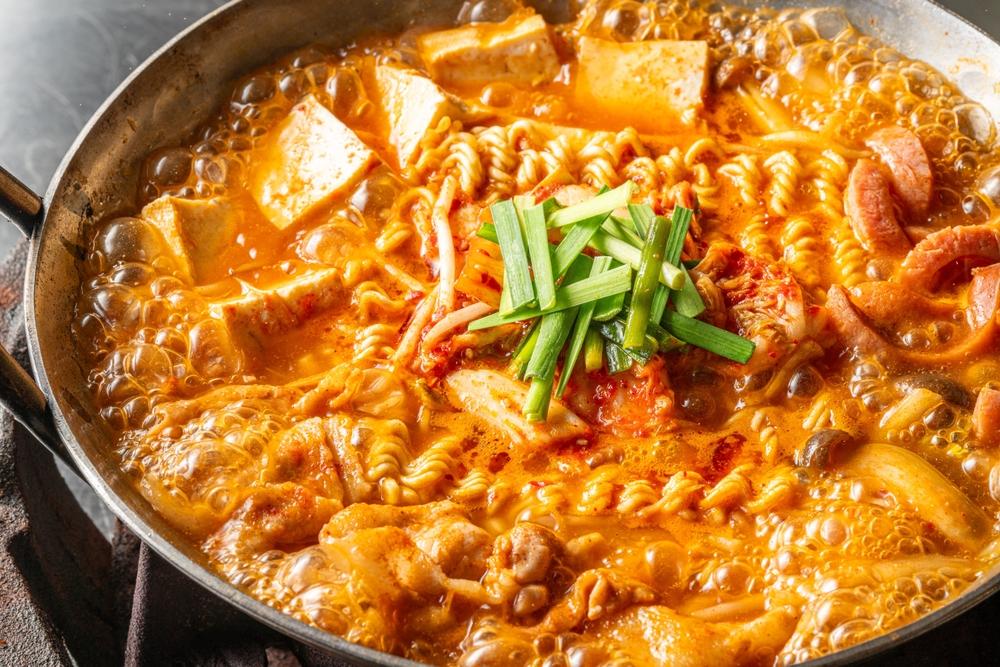
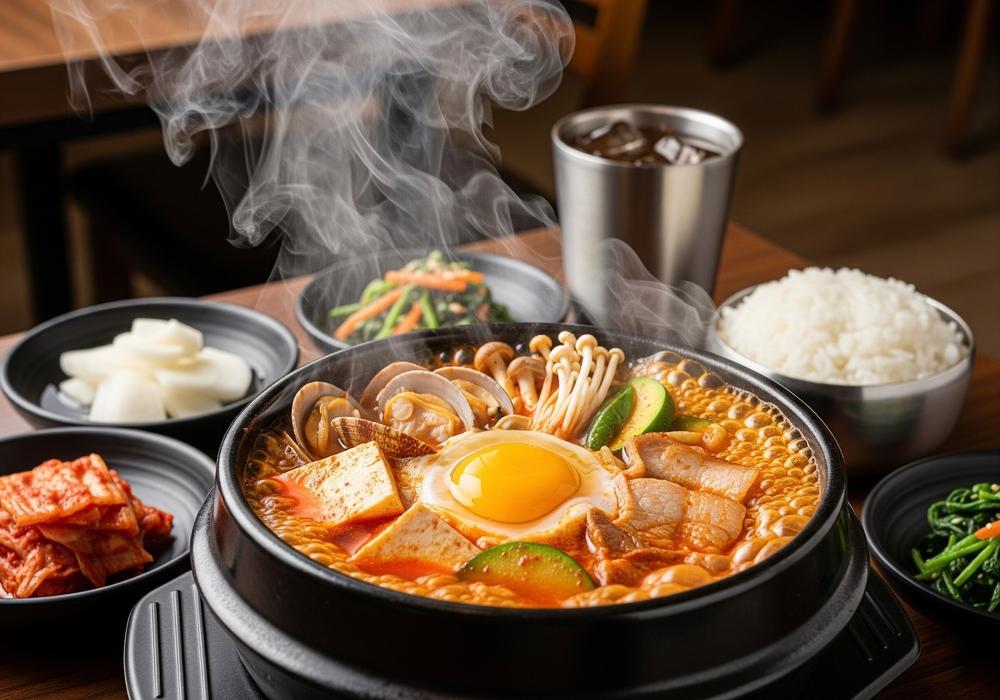
The most beloved varieties include kimchi jjigae, made from well-fermented kimchi and pork; doenjang jjigae, a savory, umami-rich stew with tofu and zucchini; and sundubu jjigae, a silky soft tofu stew that often arrives with a raw egg cracked on top. There is also budae jjigae — "army base stew" — a fascinating post-war creation born from necessity, mixing American surplus foods like Spam and hot dogs with Korean ingredients, which still carries a complex cultural weight to this day.
Each variety has its loyal following, its regional interpretations, and its emotional associations. But what they all share is this: they are meant to be eaten together.
ㅤㅤㅤㅤㅤㅤㅤㅤ
The Communal Table and the Shared Spoon
In many Western dining cultures, sharing food directly from a single vessel — using the same spoon or chopsticks that have touched your mouth — would raise eyebrows. In Korea, it is simply how meals work.
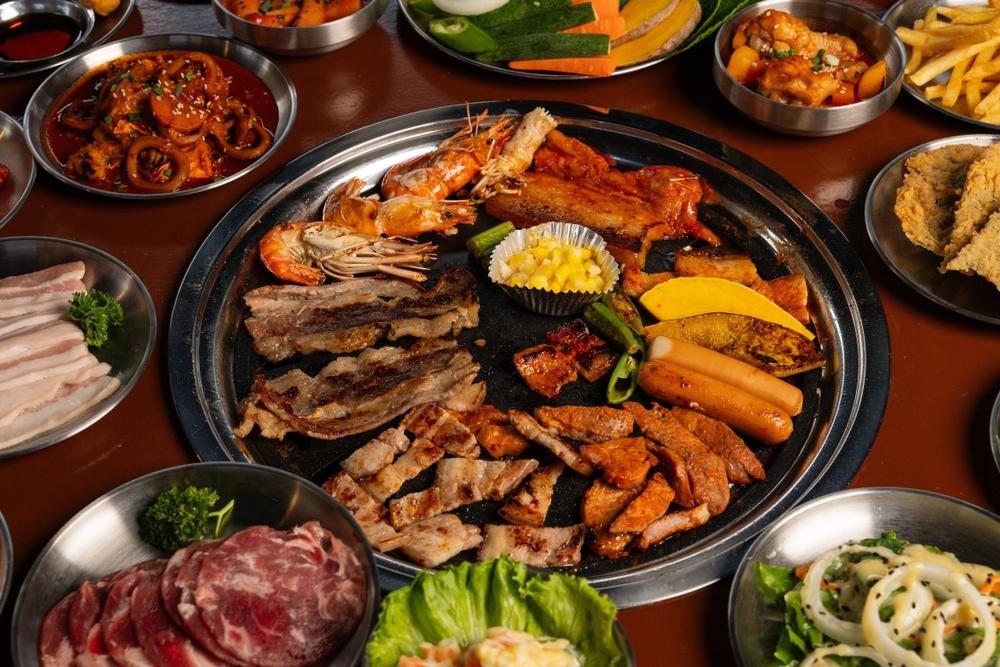
The Korean dining table is built around banchan (반찬), small shared side dishes placed at the center for everyone to reach. The jjigae sits among them, a communal anchor. You take from it, return to your rice, take from it again. No one owns it. Everyone feeds from it.
This practice reflects a broader Korean cultural value: jeong (정). Jeong is a difficult word to translate — it is something like deep emotional attachment, affection, and a sense of belonging built through shared experience over time. Sharing a pot is one of the most natural expressions of jeong. When you eat from the same bowl as someone, you are not just sharing food. You are saying, without words, I am comfortable with you. You are part of my circle.
Korean families eat this way at home. Friends eat this way at restaurants. Colleagues eat this way at lunch. The shared pot is a social equalizer, a ritual of intimacy performed daily without much thought.
ㅤㅤㅤㅤㅤㅤㅤㅤ
Jjigae and the Architecture of Korean Meals
To understand jjigae, you need to understand how Koreans think about a meal.
A Korean meal is not structured around a single centerpiece dish the way many Western meals are. It is an ecosystem. Rice is the constant, the foundation. Banchan surrounds it. Guk or jjigae provides warmth and moisture, something to sip between bites, something to soften the meal and bring it together. The rhythm is: a bite of rice, a dip into the stew, a pinch of kimchi, repeat.
Within this structure, jjigae plays a specific emotional role. It is comfort food in the truest sense — not comfort in the way of indulgence or excess, but comfort in the sense of groundedness. It is the thing that makes a meal feel complete. Koreans often say a meal without jjigae feels somehow lacking, like something is missing even when the table is full.
This is why, at Korean home meals, even when resources are limited, there is almost always a pot of jjigae. It is considered a necessity, not a luxury.
ㅤㅤㅤㅤㅤㅤㅤㅤ
A Changing Table: Individualism and the Modern Korean Meal
Here is where the story gets more complicated — and more interesting.
South Korea has undergone a dramatic social transformation over the past few decades. Rapid urbanization, economic growth, a sharp rise in single-person households, and a culture increasingly shaped by individual achievement have changed the way people live. And inevitably, they have changed the way people eat.
Honbap (혼밥) — eating alone — has gone from a quietly stigmatized act to a recognized lifestyle. Convenience stores now serve as dining rooms for millions of Koreans who heat up a single-serve meal and eat standing at a counter. Delivery apps have made it easier than ever to order a full meal for one, portioned and packaged for solitary consumption. Restaurant chains have introduced single-seat counter arrangements specifically designed for solo diners who want to eat without the social pressure of occupying a table meant for groups.
And yet, jjigae persists.
It has adapted, of course. Many restaurants now offer individual-sized jjigae pots, one per person, each arriving in its own stone bowl or small clay pot. The flavor is the same. The ritual, however, has changed. There is no reaching across the table. No shared ladle. No moment where someone tips the pot slightly toward you to make sure you get the good bits from the bottom.
What does it mean when the communal pot becomes a personal one?
ㅤㅤㅤㅤㅤㅤㅤㅤ
The Emotional Weight of Eating Together
Psychologists and cultural observers in Korea have noted that the rise of solo eating coincides with increased reports of loneliness, particularly among young adults living in cities. This is not a Korean phenomenon exclusively — it mirrors patterns seen across East Asia and in many urbanized societies worldwide. But in Korea, where communal eating has been so deeply woven into cultural identity, the shift feels particularly significant.
There is a reason Korean dramas — K-dramas — so often use food scenes as emotional turning points. A bowl of ramyeon eaten together late at night. A shared doenjang jjigae after a long day. These are not incidental details. They are shorthand for intimacy, for care, for the kind of unspoken understanding that builds between people who eat together regularly.
When jjigae is eaten alone, it still tastes good. But something about the experience changes. The warmth is still there in the pot. It just does not travel quite as far.
ㅤㅤㅤㅤㅤㅤㅤㅤ
Why This Matters Beyond Korea
As Korean food continues to grow in global popularity — driven by the spread of K-dramas, K-pop, and a genuine international curiosity about Korean culture — it is worth paying attention not just to the flavors, but to the architecture of the meal.
Jjigae invites you to slow down, to sit across from someone, to share something hot and deeply seasoned and a little bit chaotic. It is not a dish that photographs cleanly. It bubbles and spills and stains. It is meant to be consumed in the presence of others, with the kind of comfortable mess that intimacy always brings.
In a world that increasingly optimizes meals for efficiency and convenience, there is something quietly radical about a pot placed at the center of a table and the unspoken agreement that everyone at that table belongs to it.
That is what jjigae has always been. And perhaps, in its own way, that is what it continues to offer — even now, even as the table changes around it.
ㅤㅤㅤㅤ
ㅤㅤㅤㅤ
#KoreanFood #Jjigae #KFoodCulture #KoreanCuisine #KoreanFoodCulture #Hansik #KoreanCommunity #KoreanFoodBlog