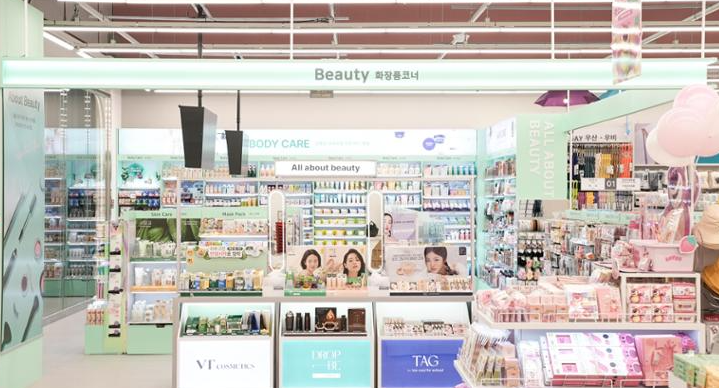
If you think you need to drop $100 at a high-end department store to get a decent face cream, South Korea’s latest beauty craze is about to prove you wrong.
Right now, the most competitive beauty destination in Korea isn’t a luxury boutique. It’s Daiso—the country's equivalent of a dollar store. But before you dismiss it as cheap, novelty makeup for kids, you need to understand the massive industry shift that is currently taking over the nation.
The Heavyweights Are Moving In
The craziest part about this trend isn't just the price; it’s who is making the products. We aren't talking about generic, white-label factories.
South Korea’s leading beauty corporations—the industry heavyweights behind some of the world's most famous premium brands—are now aggressively launching exclusive lines specifically for Daiso. Top-tier clinical skincare labels and pharmacy brands are following suit. They are creating high-concentration Cica creams, Hyaluronic Acid toners, and peptide serums, with every single item priced between 1,000 and 5,000 KRW (roughly $1 to $4 USD).
Why are famous labels rushing to a discount retailer? Because the competition in Korean skincare is so fierce, top brands are using Daiso's massive nationwide footprint to get their formulas into as many hands as possible.
It’s Not Just for Teenagers
In the US, you might assume dollar-store skincare is only for teens on a tight budget. The data in Korea says otherwise. Recent market reports show that consumers in their 30s and 40s—adults with actual purchasing power—make up over 50% of these sales.
Why? Because Korean consumers are incredibly educated about skincare ingredients. They are serious label-readers. They know that a strong, healthy skin barrier comes from proven formulations, not from a designer logo printed on a heavy glass jar. If a $3 serum from a reputable lab works, they will clear the shelves immediately.
What This Means for the Industry
This nationwide phenomenon proves one thing: the baseline quality of Korean skincare formulation is astonishingly high. The manufacturing technology is so advanced that even at a $1 to $4 price point, the efficacy rivals—and often beats—expensive Western equivalents.
It highlights a beauty culture where transparency, ingredients, and actual results matter more than the price tag. The standard for K-Beauty is simple—whether it costs $3 or $40, it has to actually work. And that relentless demand for quality is exactly why Korean skincare continues to set the global standard.