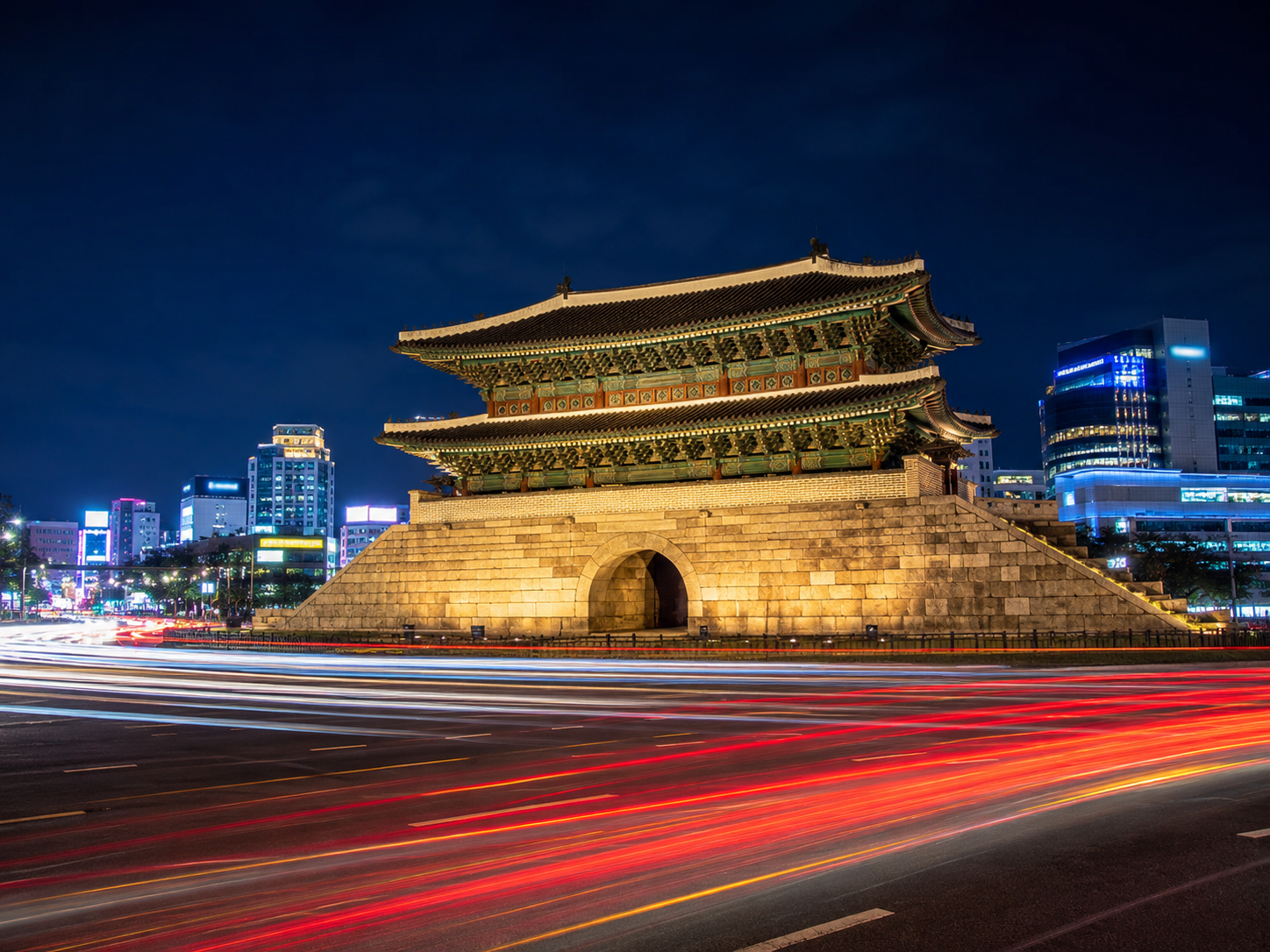

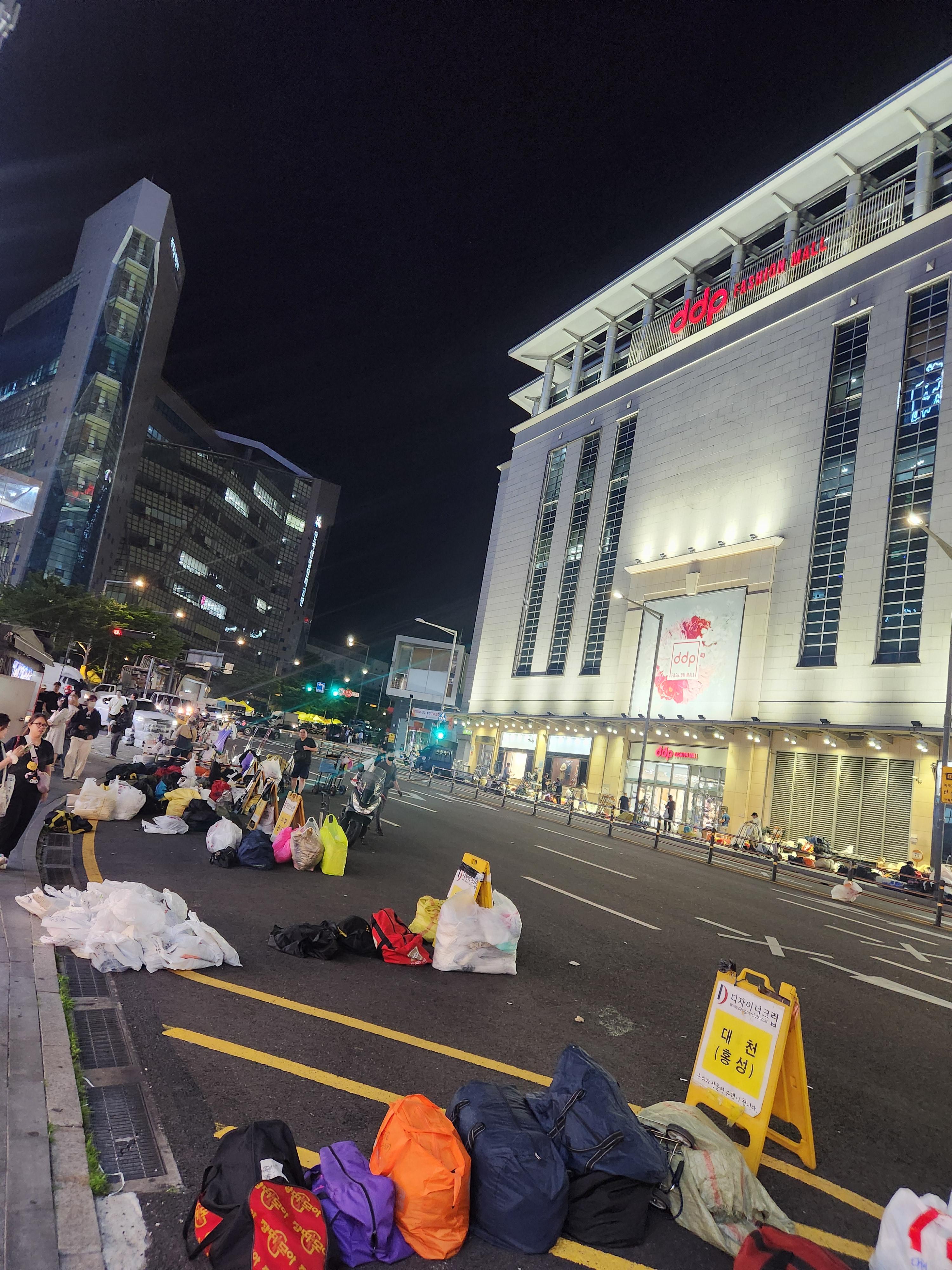
If you walk past Heunginjimun around 11 at night, the first thing you notice is the bags. Hundreds of them. Black, navy, faded red, stacked in waist-high piles right on the sidewalk and along the curb. Each pile has a small yellow sign poking out of it with a city name written in marker: 순천 (Suncheon), 구미 (Gumi), 천안 (Cheonan). These are not someone's lost luggage. They are tomorrow's inventory for clothing shops scattered across the country, and they are about to be loaded into vans that will drive through the night.
This is the part of Dongdaemun most travel guides skip. The neon, the giant Doota tower, the late-night tteokbokki — those get the photos. But the real engine of the neighborhood is running in the streets behind the malls, in the hours when most of Seoul has gone to bed.
A market that wakes up when the city sleeps
Dongdaemun has 26 shopping malls, around 30,000 specialty shops, and a wholesale district that mostly operates from about 8 PM to 5 AM. The retail malls you see lit up from the street — Migliore, apM, Doota — close around midnight. The buildings right behind them, with names like Designer's Club, Nuzzon, and apM Place, are doing the opposite. They open as the retail side winds down, and the peak hours run from roughly midnight to dawn.
Inside those wholesale buildings, almost nobody is a tourist. The shoppers are store owners from every corner of Korea, plus buyers from Japan, China, Southeast Asia, and beyond. They are walking the aisles with notebooks and phone cameras, placing orders by the bundle. The shops have no fitting rooms. Most do not take cards. The minimum order is usually two pieces per style. This is a working market, not a place designed to charm visitors, and that is exactly what makes it interesting to see.
The bags, the signs, and the people in the middle
Now back to those piles on the sidewalk. Here is how the system works. A store owner in, say, Suncheon spends the night walking through the wholesale buildings choosing inventory. She does not carry the clothes herself. Instead, every purchase gets dropped off at a designated curb spot, sorted by destination city. Some of these piles are managed by a buying agent — locally called a 사입삼촌, literally "buying uncle" — who handles the running around on behalf of out-of-town shop owners who cannot be there in person.
By around 2 or 3 AM, vans start arriving. They load up the bags by region and drive out of Seoul. By the time the first store opens in a small city the next morning, the clothes the owner picked at 1 AM in Heunginjimun are already hanging on the rack. The whole loop, from a roll of fabric at a textile shop to a hanger in a regional boutique, can happen in under a week. For fast fashion, this is one of the tightest cycles in the world.
What it feels like to actually be there
I will not pretend the wholesale market is welcoming. The aisles are tight, the sellers are busy, and if you are clearly not buying in bulk, you are usually waved through politely but quickly. The point is not to shop. The point is to walk the streets between the buildings and see a piece of Korean retail that the country runs on but rarely puts on a postcard.
The good news is the surroundings have plenty for casual visitors. The Dongdaemun Design Plaza, Zaha Hadid's silver UFO of a building, is right there and open late. The food alleys around Gwanghui-dong serve hot bowls of kalguksu and grilled skewers until very late. And looming over all of it is Heunginjimun, the old East Gate of Seoul, first built in 1398 and still standing in the middle of the traffic island. Six hundred years of history and a fashion supply chain happen on the same block.
If you want to see it for yourself
Go on a Tuesday through Friday night. Sundays are quiet because the wholesale side is closed. Aim to arrive around 11 PM if you want to catch both the retail malls before they close and the wholesale energy ramping up. Get out at Dongdaemun History and Culture Park Station, Exit 1, and walk toward the bag piles. Bring cash if you plan to buy anything, wear shoes you can stand in for hours, and try not to stand in the middle of the loading lanes. The bags have somewhere to be, and so does the van driver waiting on them.
By sunrise, the sidewalks will be clean again. The signs will be packed away. Dongdaemun will look like any other busy Seoul neighborhood waking up. But somewhere in Suncheon, in Gumi, in Cheonan, a boutique will open with clothes that did not exist on a hanger anywhere twelve hours earlier. That is the part of Korean fashion you cannot see during the day.