The KPop Demon Hunters tour is set for 2027, and BTS just broke a touring record no pop group had reached. Together, they show how K-pop has grown from music into a full cultural experience.
In May 2026, Netflix confirmed that KPop Demon Hunters, its animated film about a K-pop girl group that fights demons between performances, will become a real concert tour produced with AEG Presents. The KPop Demon Hunters tour is planned for 2027, and as of early October the official site still lists cities, dates, and tickets as coming later. A fictional K-pop group that has never existed outside a screen is being rebuilt as a live show for real audiences, at the same moment BTS is filling stadiums on one of the highest-grossing tours on record. Read together, the two stories explain what K-pop has become in 2026: less a genre people listen to and more a world people step into.
From Animation to the KPop Demon Hunters Tour
KPop Demon Hunters premiered on Netflix in June 2025. Directed by Maggie Kang and Chris Appelhans and produced with Sony Pictures Animation, it follows HUNTR/X, a girl group whose voices hold demons back, and a rival boy band hiding a demonic identity of its own. The premise is fantasy, but the songs were written and produced like real K-pop, and the soundtrack, led by "Golden," went on to behave like real K-pop on the charts. Netflix now describes it as the most popular film on the service.
What followed is the part worth noticing. They filled sing-along screenings, dressed as the characters for Halloween, and learned the choreography from short clips. A KPop Demon Hunters concert is the logical next step of that behavior: audiences already treat HUNTR/X like a group worth seeing live, so the open question is how to stage a performance for an act whose members were drawn rather than born. Netflix has said the show will bring elements of the film to life on stage. How it will work has not been announced.
One practical note for anyone searching for KPop Demon Hunters tour 2026 dates: the official production is scheduled for 2027, and the waitlist on the official site is the confirmed way to hear about cities first. Unofficial tribute shows and dance parties built around the film's music have been touring in the meantime, so it is worth checking whether an event is the Netflix and AEG Presents production before buying anything.
BTS Shows How Big K-Pop Live Experiences Can Become
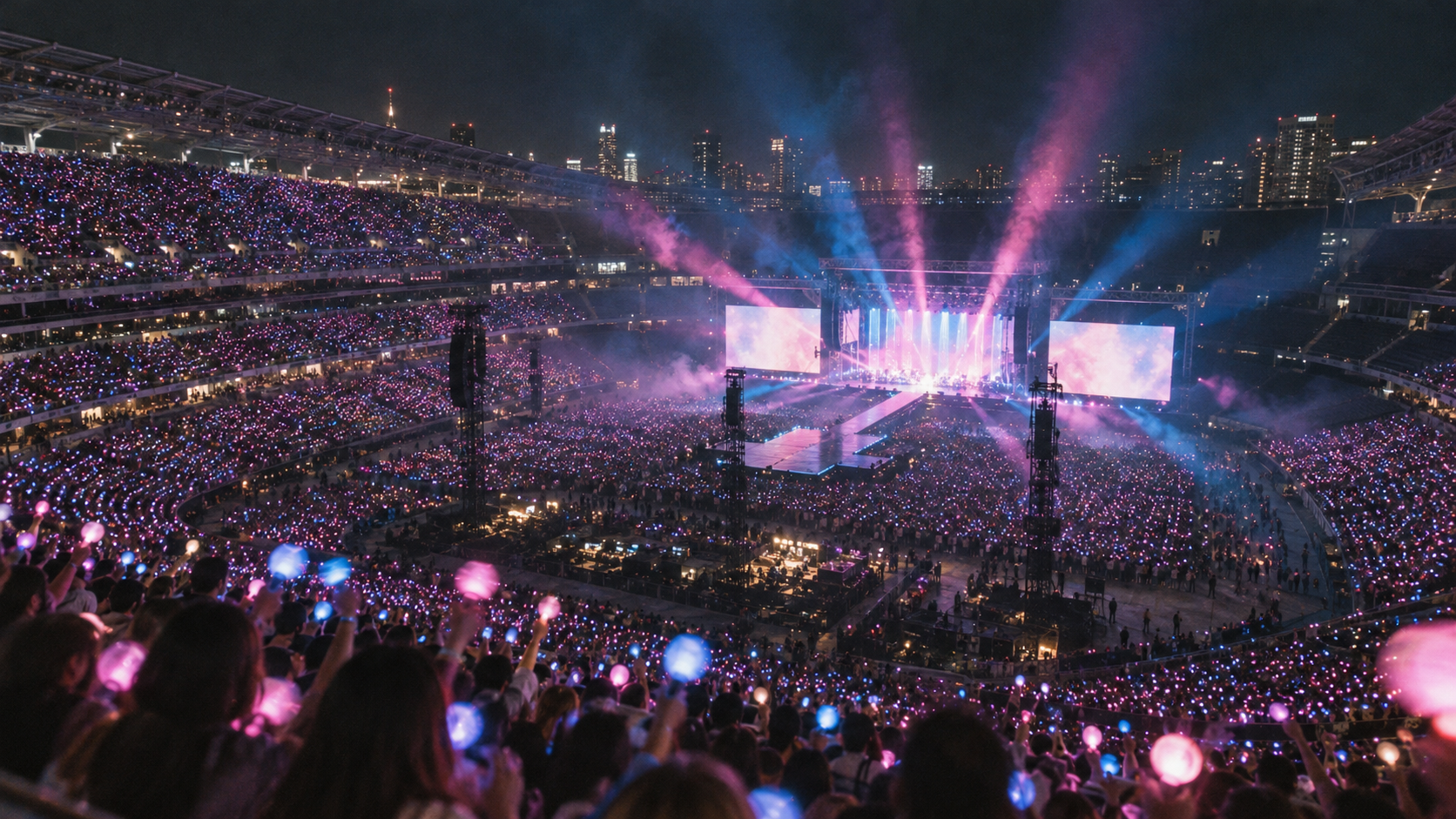
If KPop Demon Hunters shows how a K-pop world can be invented, BTS shows how large a real one can grow. The group's Arirang world tour, which opened in Goyang, South Korea, in April 2026, passed $500 million in cumulative ticket sales in Billboard Boxscore figures released at the end of September. That made BTS the first pop group to reach the mark on a single tour; the six groups that got there before them were all rock bands.
North America did much of the lifting. In August alone, BTS played 12 stadium shows across six North American cities, drew roughly 800,000 people, and grossed $171.7 million, the second-highest monthly total in Boxscore history. Two nights at MetLife Stadium in New Jersey accounted for about 158,000 tickets by themselves. At that scale, the demand behind BTS world tour 2026 tickets is no longer a niche fandom story. It is a mainstream American live-music story, and Billboard has projected that the tour could reach $1 billion by the time it ends.
What KPop Demon Hunters and BTS Have in Common
On paper, the two have little in common. One is a fictional trio created for a streaming film. The other is seven Korean artists with more than a decade of shared history, now touring as a full group again. Both succeed for the same reason: neither one is selling songs alone.
Consider what each actually offers. There is the music, of course. There is a story, whether it is HUNTR/X protecting the world through song or BTS reuniting on a global stage. There are characters and personalities that fans attach to individually, a visual identity carried through costumes, color, and stage design, and a fandom that turns watching into participating. The live show is where all of those pieces meet in a single room. This is why a K-pop concert often feels less like a performance and more like a gathering; the audience arrives already knowing the story and the choreography.
Where the Interest Goes After the Show
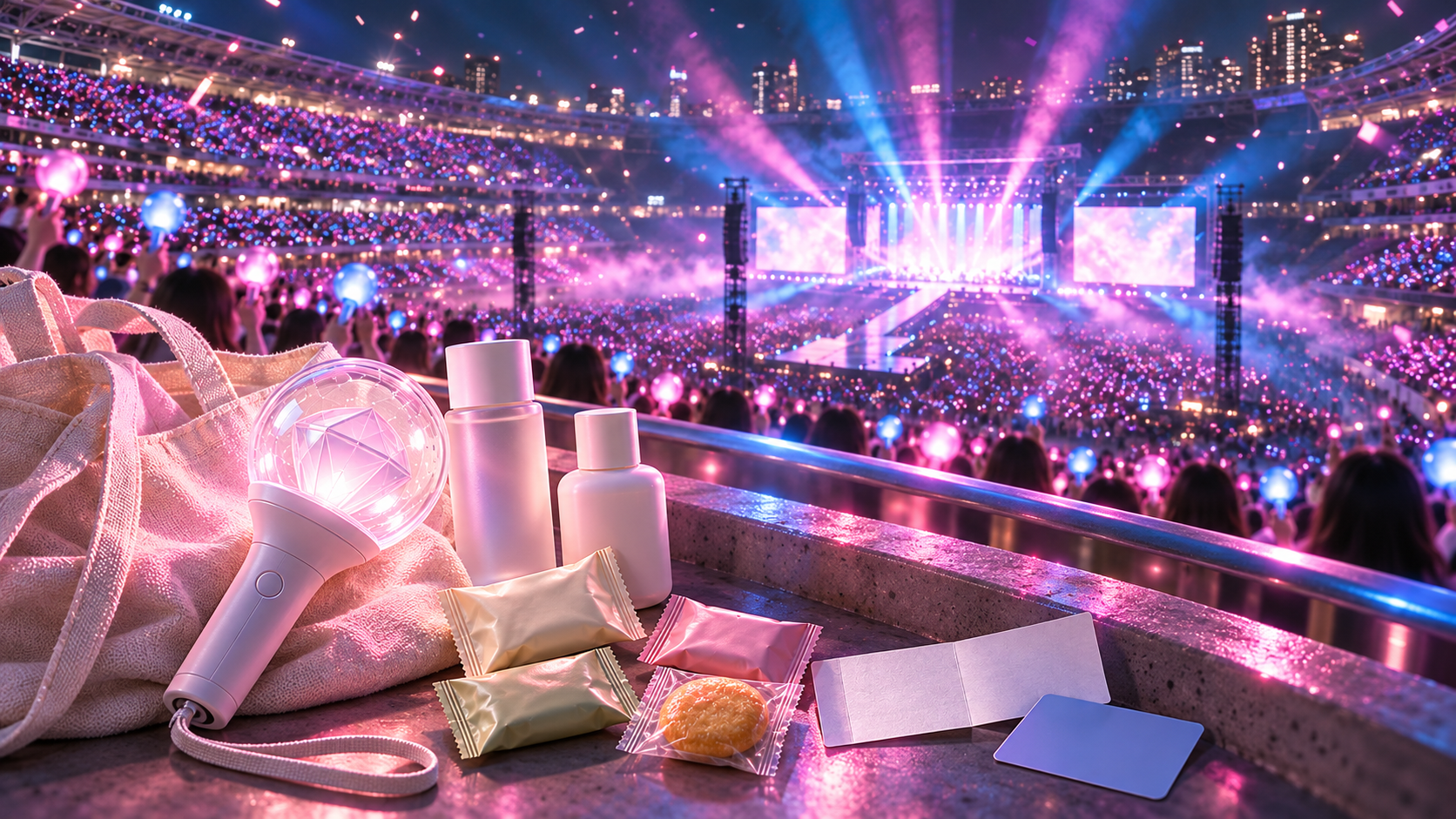
The concert ends, but the curiosity it creates usually does not. For many American fans, K-pop is the first doorway into Korea, and what sits on the other side is wider than music. A lightstick or a tour hoodie is the obvious souvenir. Less obvious is how attention drifts toward the everyday details around the music: the skincare steps idols mention in interviews, the convenience-store snacks that show up in variety clips, the street style of Seoul neighborhoods, and the late-night food shared after a show.

It would be a mistake to treat K-pop as a summary of Korean culture. It is one export among many, and a carefully produced one. It is often the first, though, and first impressions shape what people look for next. KPop Demon Hunters makes the point quietly by setting its story in Seoul, so viewers come away with a sense of the city alongside the songs.
That path, from the music to daily life, is the one K Gallery tries to follow: from the stage to the bathroom shelf, the pantry, the closet, and the small objects on a Korean desk. You do not need to be a dedicated fan to start there.
The KPop Demon Hunters tour and the Arirang stadium run arrive from opposite directions. One is turning a fictional group into a live act; the other is a real group showing how far a live act can travel. They meet in the same place, a shared experience that starts with a song and keeps going long after the encore. That is the version of K-pop worth watching in 2026, and it is likely the version that shapes what comes next.