Male K-pop idols include soloists and boy group members developed and promoted within Korea’s idol industry. Learn how training, group roles, comeback promotions, and fan culture work—and how to start exploring without relying on popularity rankings
Male K-pop idols are soloists and boy group members developed and promoted within Korea’s idol industry. The term describes more than a singer: many idols combine vocals, rap, dance, stage performance, media appearances, and regular communication with fans. Many also pass through an agency’s trainee system before debut, although there is no single route that every artist follows.
This guide explains the system, the common role labels inside boy groups, and the fan culture surrounding their work. It is an introduction, not a ranking of the most popular or best-looking artists.
What makes someone a male K-pop idol
The clearest definition is based on the industry and promotional system around the artist, not nationality. Male K-pop idols can be soloists, members of boy groups, or group members who later release solo music. They usually work with a Korean entertainment company or within Korea’s idol-production system, release music for the Korean market, and promote through a mix of music programs, concerts, variety content, social media, and fan platforms.
They do not all have Korean passports. K-pop groups have long included members from Japan, China, Thailand, the United States, Canada, Australia, and other countries. Their participation in the Korean idol industry—not ethnicity alone—is what connects them to K-pop.
The job also extends beyond recording songs. Depending on the artist and project, an idol may learn choreography, film music videos, perform on television, host livestreams, appear in entertainment programs, act, model, or participate in songwriting and production. The balance differs by person and group.
From trainee to debut
Many idols begin as trainees, or yeonseupsaeng in Korean. Agencies recruit potential performers through auditions, casting, referrals, or online applications, then evaluate whether they are ready for a debut team. Training commonly includes vocals and dance and may also cover rap, languages, fitness, stage performance, interviews, or media skills.
There is no standard training period. Some trainees debut within months, while others train for several years, move between companies, or never debut. Agencies may assemble a lineup internally, introduce trainees through pre-debut content, or form a group through a televised survival program. Training is therefore a common feature of the idol system, not a guarantee or a single fixed process.
The roles inside a boy group
Fans, media, and some agencies use role labels to describe how members are presented within a group. These terms are useful shorthand, but they are not governed by a universal industry rule and they do not rank one member above another.
· Leader: Often represents the group in introductions, interviews, and formal remarks. The role varies, and the leader is not always the oldest member.
· Main or lead vocalist: Labels sometimes used for members who take prominent or technically demanding vocal parts. The distinction between main and lead is not standardized across every company.
· Main or lead dancer: Labels for members who are especially prominent in choreography or dance-focused sections.
· Rapper: A member who performs rap parts. Some idol rappers also write lyrics or participate in production, while others work from material created with producers.
· Maknae: The youngest member. The Korean word also applies to the youngest person in families, workplaces, and other groups.
· Visual: A subjective promotional label associated with the group’s image. Many groups do not assign it officially.
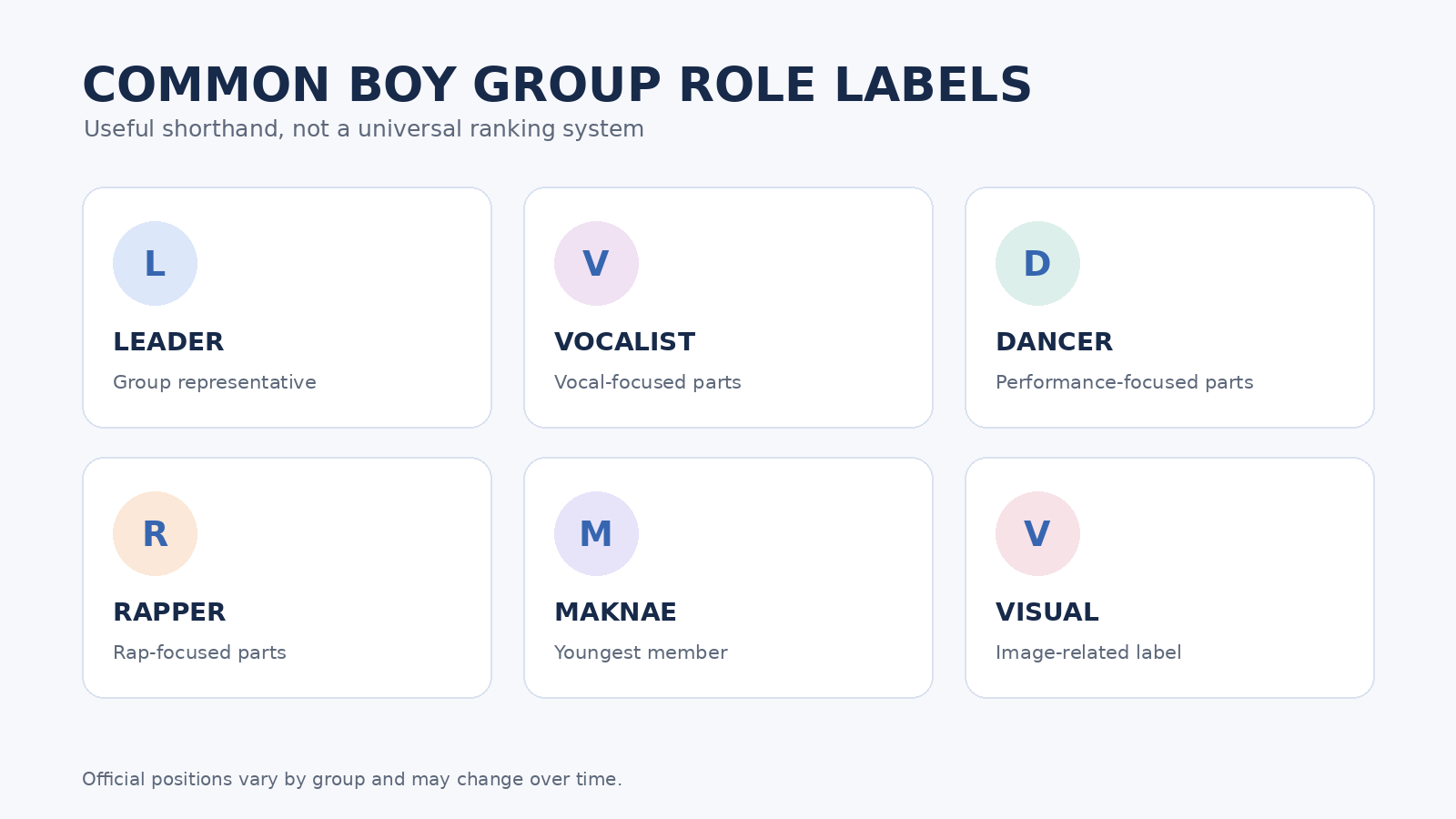
Some agencies publish positions when a group debuts; others avoid fixed titles or stop emphasizing them later. Members may also take different parts from one song to another. For a specific group, an official agency profile or the members’ own introductions are more reliable than a fan-made position list.
What male K-pop idols do after debut
K-pop schedules often revolve around a comeback—the industry term for a new release and its promotion period, even when the artist has not been inactive for long. A comeback may include several kinds of work:
· Albums and music shows. Artists release a single, EP, or album and may perform the lead track on weekly Korean music programs. Winning formulas differ by program and can include digital performance, physical sales, broadcast activity, and fan voting.
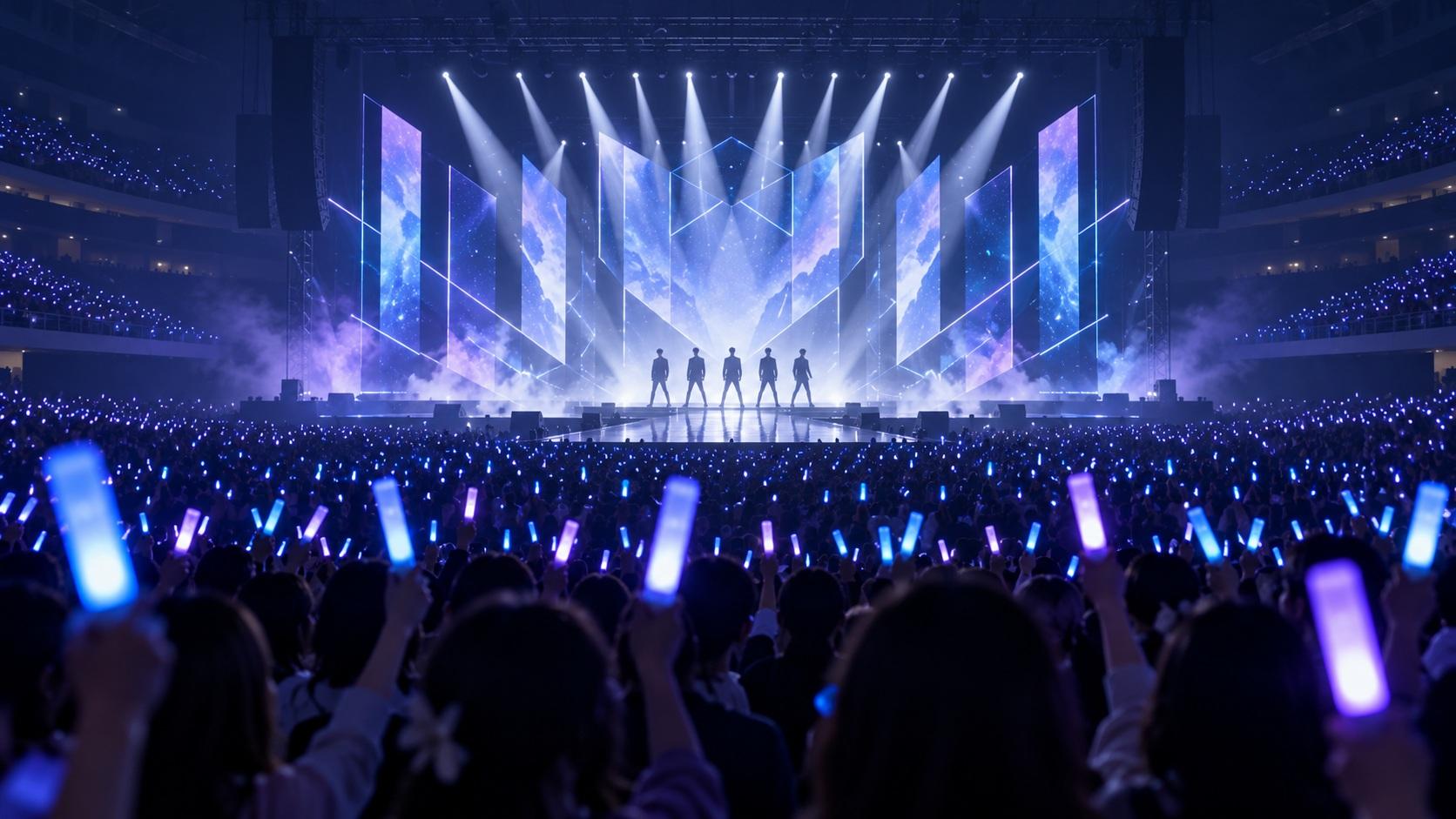
· Concerts and world tours. Touring can take groups across Korea, Asia, North America, Europe, and other regions.
· Solo and unit work. Members may release solo music, form sub-units, or collaborate outside the group.
· Variety, acting, fashion, and brand work. Idol careers often extend into entertainment programs, dramas, films, magazines, and commercial partnerships.
· Fan platforms and social media. Official content appears across services such as YouTube, TikTok, Instagram, X, and Weverse. Paid messaging services such as Bubble deliver artist messages in a chat-style interface, but the experience should not automatically be treated as a private one-to-one friendship.
K-pop fan culture, explained for American readers
Several practices may feel unfamiliar to someone coming from American pop fandom. Korean music shows combine weekly performance stages with chart-style competition. Fans may apply to attend pre-recordings, learn official cheers, and celebrate a first music-show win as a career milestone.
A fansign gives selected fans a short interaction and autograph with an artist. Many events use a lottery in which eligible album purchases from a participating retailer count as entries, although rules vary by event. Buying more entries does not guarantee selection.
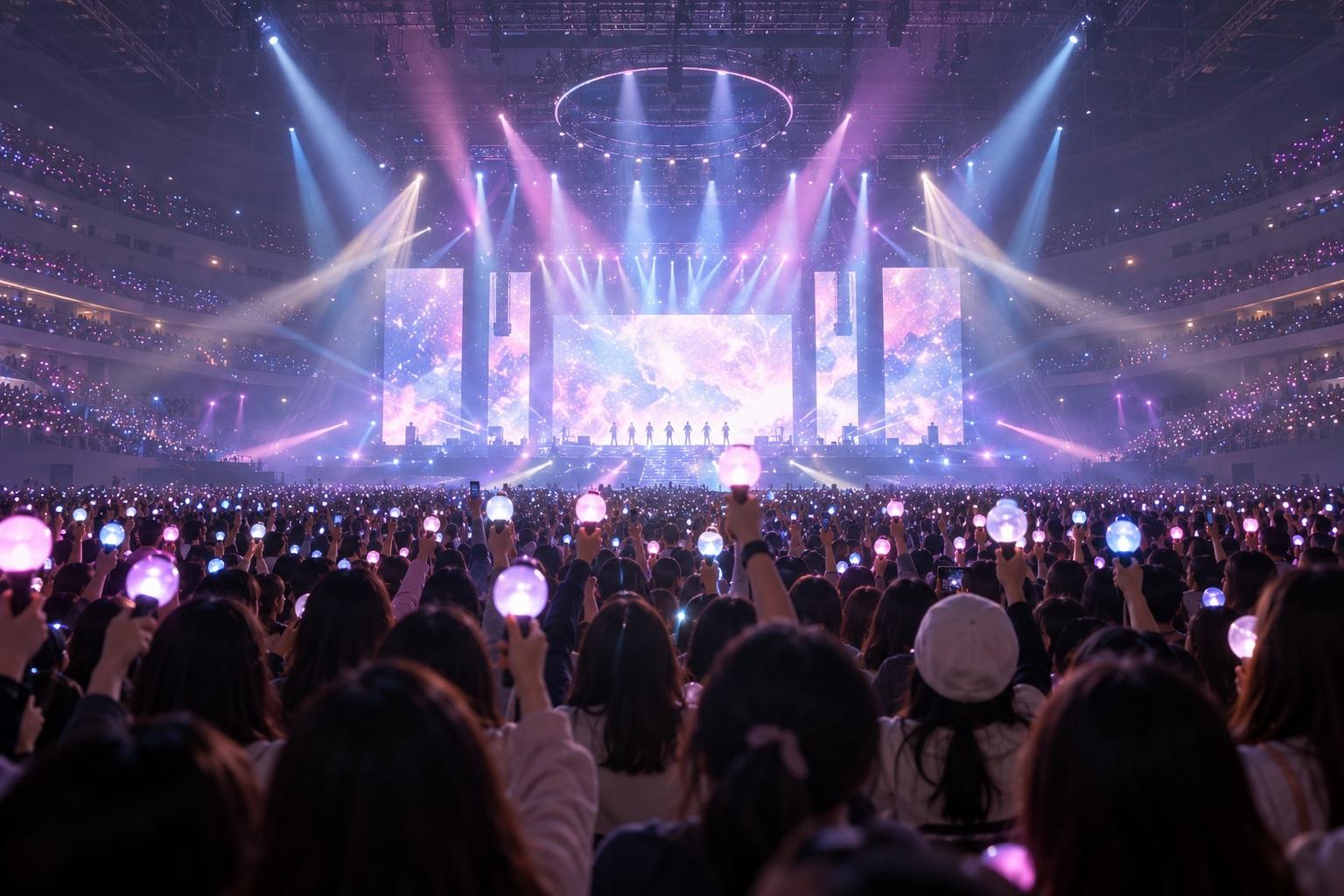
Fanchants, or eungwonbeop in Korean, are coordinated cheers performed at specific points in a song. Agencies or artists sometimes publish official guide videos. Fandoms may also have an official name, a light stick, or organized slogan events at concerts, but these practices are not identical for every artist.
Three groups, three different working models
Specific examples are more useful when they show different structures rather than claim that one group is best.
SEVENTEEN debuted under Pledis Entertainment in 2015 with 13 members organized into hip-hop, vocal, and performance units. Its official profile emphasizes members’ participation in album production, while outside collaborators and staff also contribute to the finished work.
Stray Kids debuted under JYP Entertainment in 2018. Bang Chan, Changbin, and Han work together as 3RACHA, the group’s producing team, and JYP’s official materials credit them across the group’s songwriting and production. That creative structure is a defining feature of Stray Kids, but it is not a requirement for every idol group.
NCT was introduced by SM Entertainment in 2016 with an open-ended membership and sub-unit concept. The broader project has included units such as NCT 127, NCT DREAM, WayV, NCT U, and NCT WISH. SM announced in 2023 that the infinite-expansion model would end, so the original concept should not be described as an unlimited system that is still adding units indefinitely.
Male idols can also appear in cultural and public campaigns beyond entertainment. In September 2018, BTS attended a Generation Unlimited event at the United Nations, where RM delivered a speech connected to the group’s work with UNICEF. Examples like this show cultural reach, but they do not create a ranking of artists or fandoms.
What K-pop generations mean
Boy groups are often described as second-, third-, fourth-, or fifth-generation acts. These labels loosely group artists by debut period and shifts in the industry. There is no official boundary accepted by every company, media outlet, or fan community, so generation labels are best treated as a convenient timeline rather than a fixed rule.
How to start exploring
Start with the kind of music and performance you already enjoy, not with a popularity ranking. A practical route is:
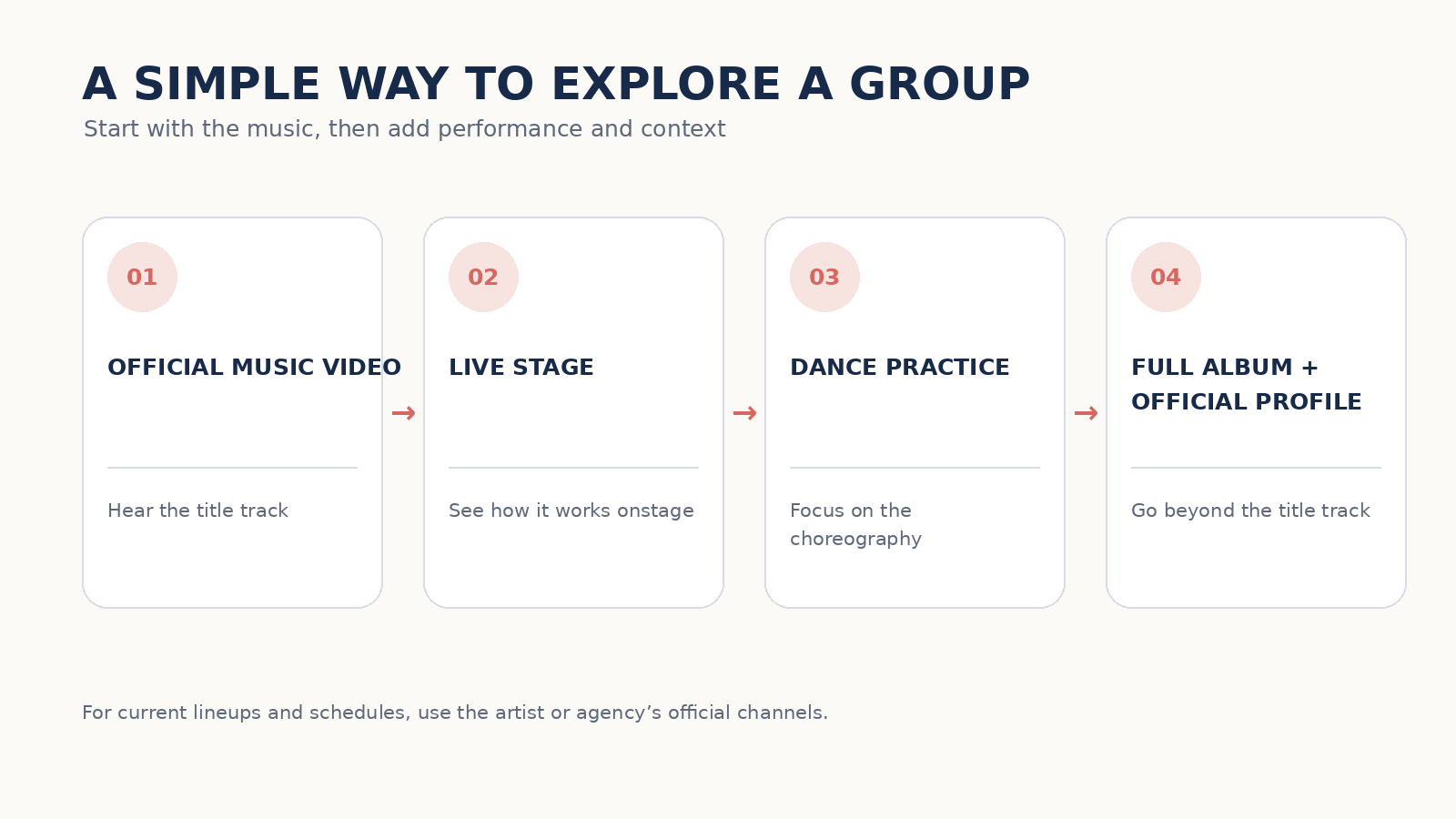
1. Watch an official music video on the artist’s or agency’s verified channel.
2. Find a live stage of the same song to see how it is performed for television or an audience.
3. Watch a dance-practice or performance video to focus on choreography and formations.
4. Try the full album, then use official profiles and social accounts to confirm the current lineup, releases, and schedule.
You may prefer a vocal-focused soloist, a hip-hop-oriented group, a band-style act, or a performance-heavy team. That preference is a better starting point than treating fan votes as an objective measure of quality.
Frequently asked questions
Are all male K-pop idols in boy groups?
No. Some debut as soloists, and many group members later release solo music or work in sub-units.
Do all idols go through the same training?
No. Training length, curriculum, audition route, and debut process vary by agency and artist. Some performers follow less conventional paths.
Can someone who is not Korean be a male K-pop idol?
Yes. K-pop groups include members from many countries. Participation in Korea’s idol-production and promotion system matters more than nationality alone.
Who is the most popular male K-pop idol?
There is no single objective answer. Streams, sales, tour attendance, brand metrics, and fan votes measure different things, and each changes over time.
Image credits: K Gallery original AI-generated image and original graphics.