How the 1990s Rewrote the Rules of Korean Music
In 1992, a three-member group called Seo Taiji and Boys walked onto a Korean television talent show and performed a song that the judges didn't quite know what to do with. The music mixed rap, rock, and dance in a way that had never been heard on Korean mainstream television. The judges gave them the lowest score of the evening. The audience, however, had a different reaction entirely — and within weeks, the song was everywhere.
(Source: Seotaiji-Archive)
That performance is now widely considered the moment modern Korean popular music was born. Not because the song was perfect, but because it was different in a way that couldn't be ignored. Korea in the early 1990s had a music industry dominated by ballads, trot, and adult-oriented pop. What Seo Taiji and Boys introduced was something aimed directly at young people — a generation that was growing up faster, consuming global media, and looking for music that sounded like how they felt.
The group didn't just change the sound of Korean pop music. They changed its attitude. Songs addressed social issues, school pressure, and the anxieties of youth. Young Koreans who had grown up in a rapidly industrializing country, watching their parents work long hours for a future that didn't always include room for self-expression, suddenly heard music that spoke to them directly. Seo Taiji and Boys became a cultural phenomenon before the term "K-POP" even existed.
(Source: MBCkpop)
When the group disbanded in 1996, the music industry faced a question: what comes next? The answer came quickly. SM Entertainment, watching the massive youth audience that Seo Taiji and Boys had built, decided to channel that energy into a new kind of group — one that could be professionally trained, visually coordinated, and strategically introduced to young fans.
The result was H.O.T. — High-five Of Teenagers. Debuting in 1996, they are widely recognized as Korea's first modern idol group. They had synchronized choreography, matching outfits, a defined concept, and an organized fan base. They also had something relatively new in Korean music at the time: a dedicated, passionate, and vocal fandom that treated the group members like genuine stars.
H.O.T. sold out stadiums and sparked a fan culture that would define the next three decades of Korean entertainment. Their concerts were events, not just shows. Fans prepared banners, fan chants, and coordinated outfits. The template for what a K-POP fandom looks and sounds like today was being written in real time.
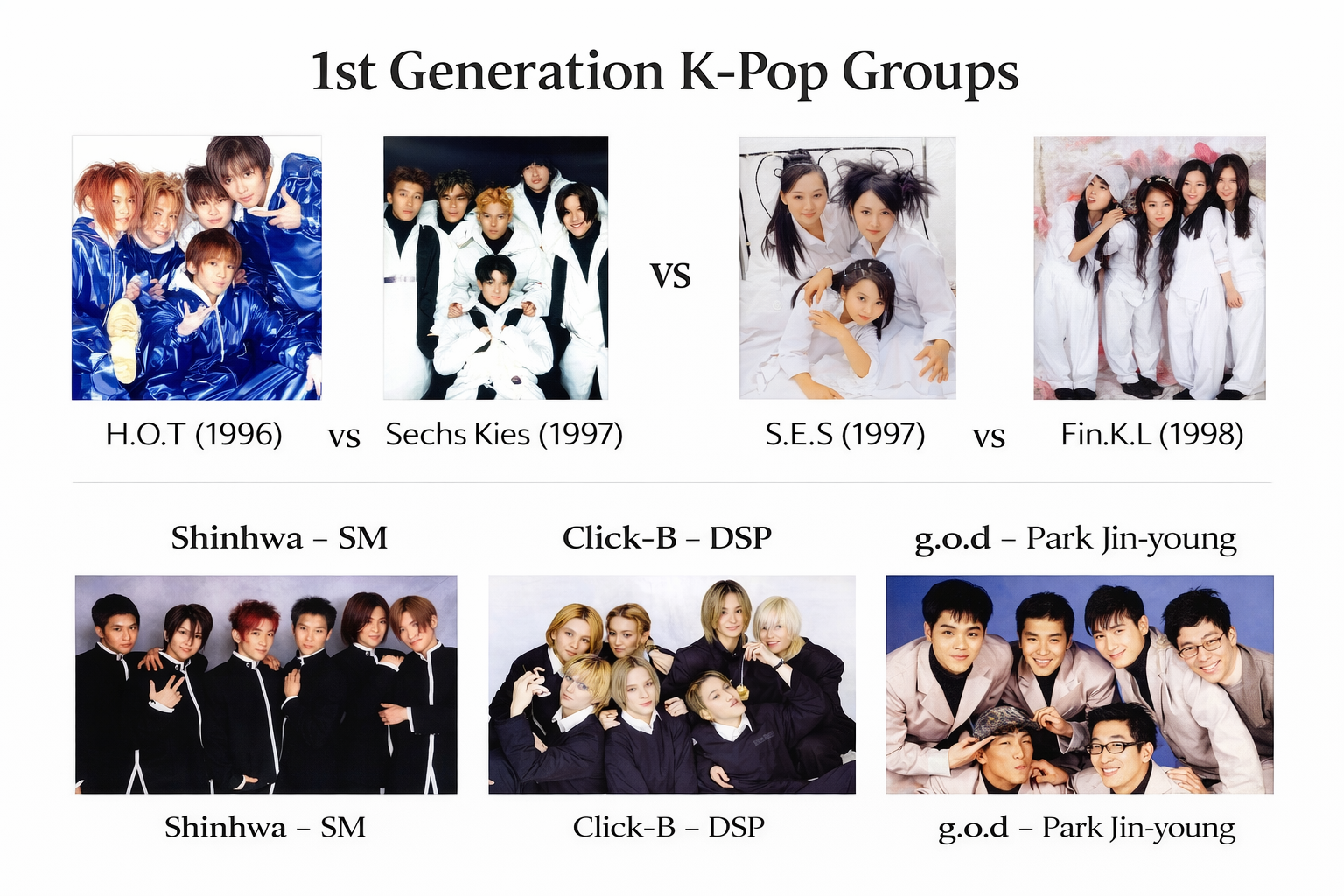
Other groups followed. g.o.d, Shinhwa, S.E.S., and Fin.K.L. expanded the first generation of K-POP. Each brought something slightly different, but all operated within a shared framework: talented performers, professional management, and a deep connection with a youth audience hungry for something to call their own.
Looking back, the line from Seo Taiji's restless creativity to the global reach of today's K-POP is not as long as it might seem. Someone had to break the old rules of Korean pop music first. And someone had to build the new ones. Both things happened in the same decade — and the industry that emerged from those years became one of the most influential in the world.
#KPOP #KPOPHistory #SeoTaiji #HOT #FirstGenKPOP #KoreanMusic #KPOPOrigins #HallyuBegins