
Learn how to say goodbye in Korean the way native speakers do, with 8 common phrases, the difference between annyeonghi gaseyo and annyeonghi gyeseyo, and when to use polite or casual forms.

How to Say Goodbye in Korean
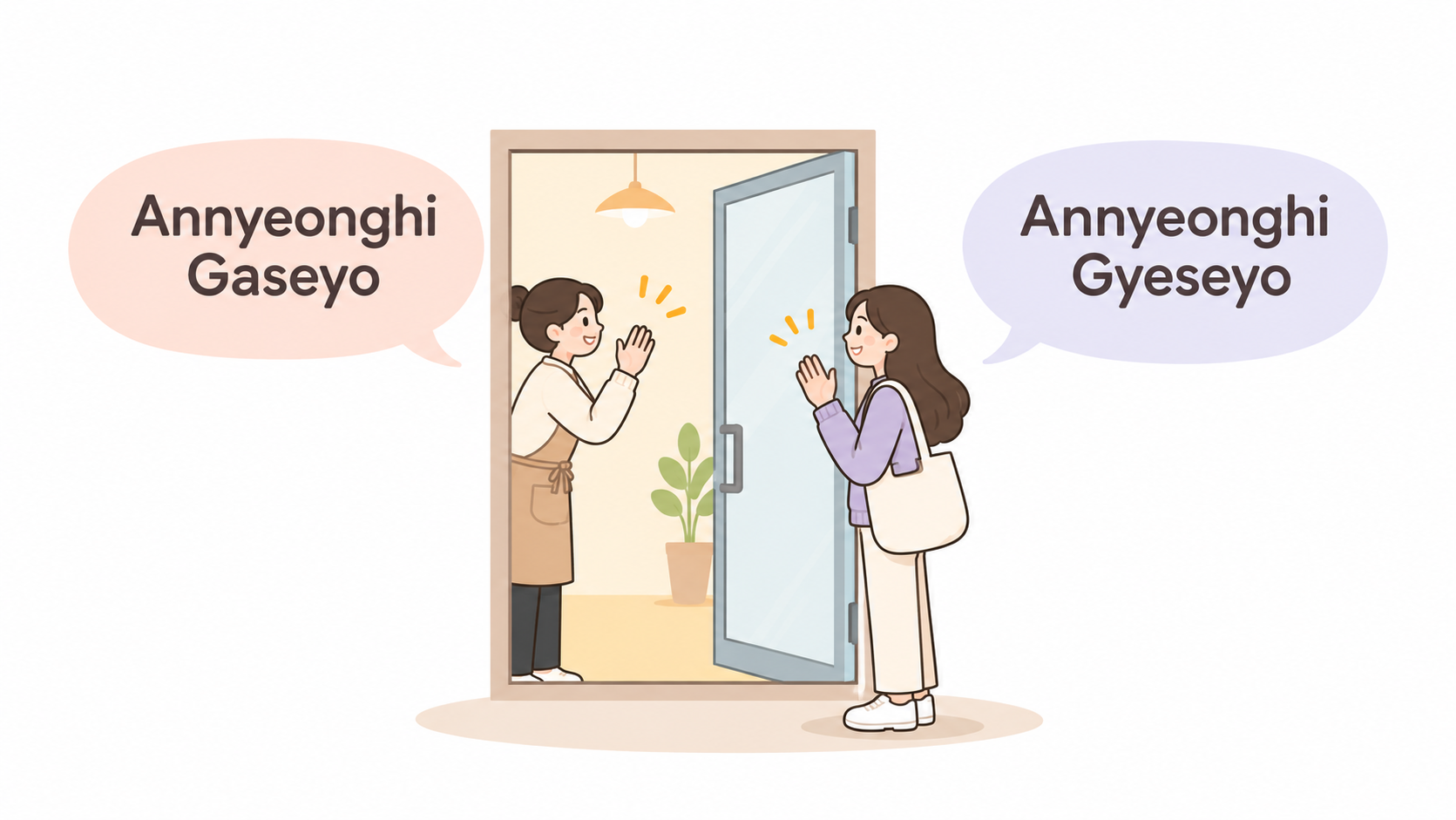
Ask a Korean speaker how to say goodbye in Korean, and the honest answer starts with a question of its own: who is leaving? Korean has no single word that covers every farewell the way “goodbye” does in English. The two phrases you will hear most are 안녕히 가세요 (annyeonghi gaseyo), said to someone who is leaving, and 안녕히 계세요 (annyeonghi gyeseyo), said to someone who is staying while you go. Among close friends, a simple 안녕 (annyeong) works in either direction.
Korean greetings, and farewells in particular, depend on two things at once: who is moving and how well the two speakers know each other. Once those ideas settle in, the rest of the vocabulary is easy to place.
Annyeonghi Gaseyo vs. Annyeonghi Gyeseyo
Both phrases open with 안녕히 (annyeonghi), an adverb built from 안녕, meaning peace or well-being. The difference lives entirely in the verb. 가세요 (gaseyo) comes from 가다, “to go,” so annyeonghi gaseyo means “go in peace.” 계세요 (gyeseyo) is the honorific form of 있다, “to stay” or “to be,” so annyeonghi gyeseyo means “stay in peace.”
The practical rule follows from the literal one. When a guest heads out of your home, you say annyeonghi gaseyo. When you are the guest walking out the door, you say annyeonghi gyeseyo to your host. And when two people part on the street and both walk away, each says annyeonghi gaseyo, since nobody is staying behind.
Learners mix these up constantly, partly because gaseyo and gyeseyo sound alike in fast speech. A quick check before you speak helps: is the other person going, or staying?
8 Common Ways to Say Goodbye in Korean
These are the farewells you are most likely to hear in daily life. Several of them are not literally “goodbye” at all; they are wishes, promises, or small announcements that Koreans use to close a conversation.
- 안녕히 가세요 (annyeonghi gaseyo): “Go in peace.” Polite. Said to someone leaving while you stay, and safe with strangers, elders, and customers.
- 안녕히 계세요 (annyeonghi gyeseyo): “Stay in peace.” Polite. Said when you are the one leaving, for example to a host or a teacher.
- 안녕 (annyeong): “Bye,” and also “hi.” Casual. It works whether you are leaving or staying, but only with friends, younger people, or others you are close to.
- 잘 가 (jal ga): “Go well.” Casual, said to a friend who is leaving. The polite form, 잘 가요 (jal gayo), is friendly but less formal than annyeonghi gaseyo.
- 나중에 봐요 (najunge bwayo): “See you later.” Polite and open-ended. Drop the final 요 and it becomes the casual 나중에 봐 (najunge bwa).
- 내일 봐요 (naeil bwayo): “See you tomorrow.” Common between classmates and coworkers. The casual form is 내일 봐 (naeil bwa).
- 잘 들어가 (jal deureoga): Literally “go in well,” meaning “get home safe.” Casual. The polite version is 잘 들어가세요 (jal deureogaseyo).
- 먼저 갈게요 (meonjeo galgeyo): “I’ll go first.” Polite, used when you leave before others at a dinner, a party, or the office. Among friends it becomes 나 먼저 갈게 (na meonjeo galge).
Formal vs. Informal Goodbyes in Korean
Korean speech is often described in two broad registers: 존댓말 (jondaetmal), polite or honorific speech, and 반말 (banmal), casual speech. For goodbyes, the clearest marker is the ending. Phrases ending in -요 (-yo) are polite, and dropping the -요 usually gives you the informal version, so 내일 봐요 becomes 내일 봐 and 잘 가요 becomes 잘 가.
An informal goodbye in Korean is not rude in itself. Between friends of a similar age, 안녕 or 잘 가 sounds warm, and full polite forms can even feel a little distant. The trouble starts when banmal is used with someone who has not invited it, such as an older person, a new acquaintance, or a manager. For visitors and new learners, polite speech is the sensible default until the other person signals otherwise.
A rough guide by relationship:
- Close friends and younger siblings: 안녕, 잘 가, 나중에 봐, 잘 들어가
- Coworkers and acquaintances: 내일 봐요, 먼저 갈게요, 잘 들어가세요
- Elders, teachers, customers, and strangers: 안녕히 가세요, 안녕히 계세요
You will also hear 안녕히 가십시오 (annyeonghi gasipsio) and 안녕히 계십시오 (annyeonghi gyesipsio), the most formal versions. They belong mostly to broadcasts, announcements, and staff seeing customers out, so recognizing them matters more than using them.
Korean Goodbyes in Everyday Life
What makes Korean farewells distinctive is how often they turn toward the other person’s trip home rather than the parting itself. 잘 들어가 is the clearest case. Friends say it at a subway entrance or a bus stop late at night, and it carries a quiet “let me know you got back okay” without spelling it out. 조심히 가 (josimhi ga), “go carefully,” does similar work, especially in rain or snow. Both turn up often in K-dramas at the end of a night out, just before the characters split up.
The office has its own rhythm. Someone leaving before colleagues will often say 먼저 가 보겠습니다 (meonjeo ga bogetseumnida), a more formal relative of meonjeo galgeyo, and those still at their desks commonly answer 수고하셨습니다 (sugohasyeotseumnida), roughly “thank you for your hard work.” Even here, there is no grammatical rule fixing one correct phrase, and habits vary by company and by generation.
In shops and restaurants, staff usually send customers off with annyeonghi gaseyo or the formal annyeonghi gasipsio. Customers reply in different ways depending on the place and the moment, which is a useful reminder that these phrases are guides, not a script.
A few short exchanges show how it sounds in practice.
Two friends at a subway station:
A: 나 먼저 갈게. (Na meonjeo galge.) “I’m heading off first.”
B: 응, 잘 들어가! (Eung, jal deureoga!) “Okay, get home safe!”
Leaving a friend’s family home:
You: 안녕히 계세요. (Annyeonghi gyeseyo.) “Goodbye.” (Literally, “stay in peace.”)
Friend’s mother: 그래, 조심히 가. (Geurae, josimhi ga.) “All right, go carefully.”

Leaving the office:
You: 먼저 가 보겠습니다. (Meonjeo ga bogetseumnida.) “I’ll be heading out first.”
Coworker: 네, 수고하셨습니다. 내일 봐요. (Ne, sugohasyeotseumnida. Naeil bwayo.) “Thanks for your hard work. See you tomorrow.”
Notice the second exchange. The younger visitor uses polite speech, while the older host answers in banmal. That asymmetry is normal, and it is one of the clearest windows into how age and relationship shape everyday Korean.

Say Goodbye Naturally in Korean
The right farewell is the one that fits two facts: who is walking away, and who you are talking to. Get those right and even a short 잘 가 or 안녕히 계세요 lands the way it should. Get the second one wrong, and the words can be perfectly correct while the tone is not.
Most Koreans learned these habits long before they learned the grammar behind them. Listening for them, in a drama, a café, or a late-night goodbye at the station, is the fastest way to pick them up yourself.