Learn the polite saengil chukahaeyo, the casual and honorific versions, and ready-to-send birthday messages for friends, coworkers, and grandparents.
How do you say happy birthday in Korean? A common polite greeting is saengil chukahaeyo. It is the polite way to wish someone a happy birthday, the version you can use with a coworker, a classmate you are not close to yet.
Korean has more than one way to say it, though, and the right choice depends less on the occasion than on how you already speak to the person. Before getting to that, it helps to be able to say the basic phrase out loud.
Saying it out loud, one piece at a time
The greeting splits cleanly into two parts:
saengil: birthday. Say it in two beats, saeng-il.
chukahaeyo: congratulations, in polite speech. Four beats, chu-ka-hae-yo.
The spelling of the Korean word for congratulations puts a "k" sound right before an "h" sound, but in speech the two merge into a single, slightly breathy k. That is why the phrase is usually romanized as chukahaeyo rather than something closer to the spelling. Practice each half on its own, then join them with a small pause: saengil, chukahaeyo. In natural speech the two words flow together, but the pause is fine while you are learning.
Match the greeting to how you already talk
Two terms you will often hear are banmal, casual speech, and jondaenmal, polite speech. A birthday greeting simply follows whichever style you already use with that person:
A close friend you talk to in banmal: saengil chukahae
A coworker you speak to in jondaenmal: saengil chukahaeyo
Your grandmother or grandfather: saengsin chukadeuryeoyo
A group, a speech, or a formal card signed by a whole team: saengil chukahamnida
It is tempting to assume age decides all of this. Age does play a part when two people first work out how to speak to each other, but once a style is settled, it is the relationship that carries it. Two coworkers born in the same year may still use jondaenmal with each other, and if that is how you talk with a colleague, a sudden saengil chukahae on their birthday may feel unexpectedly familiar. Keep the style you already share. If you have hardly spoken with someone, the polite haeyo form is a useful starting point.
Why you might say saengsin to a grandparent
saengsin also means birthday, but it is the honorific word for it, a way to show respect for the person celebrating. Korean has a small group of nouns that work like this, where the respect attaches to something that belongs to the person you are honoring. It is why you would ask about a grandparent's saengsin but would normally avoid the word for your own birthday.
The verb shifts too. Chukahaeyo becomes chukadeuryeoyo, built on deurida, a humble way of saying "to give." The wording expresses deference to the person you are congratulating. Set side by side, the two polite greetings look like this:
To a coworker: saengil chukahaeyo
To your grandmother: Halmeoni, saengsin chukadeuryeoyo
Both are jondaenmal, and both are entirely polite. What differs is the degree of respect, and that is the useful thing to notice: polite speech is not a single setting. Within it, you still pick the words that fit the person in front of you. saengsin chukadeuryeoyo suits grandparents, parents, and other elders you speak to with special respect. With coworkers, follow the wording you normally use with that person.
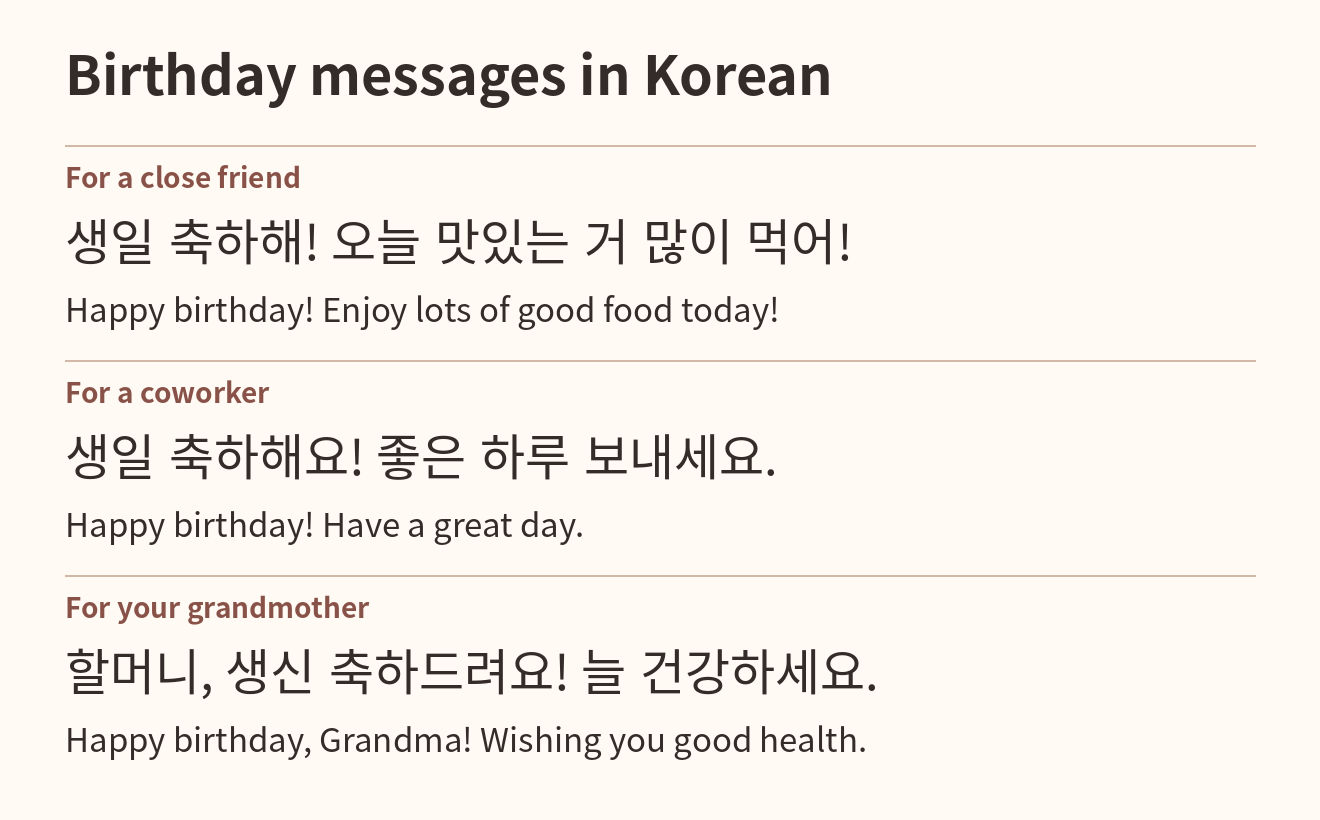
On a card or in a text, the greeting can stand on its own. If you add a short wish after it, that second sentence should stay in the same speech style as the first. Here are three examples you can practice aloud.
For a friend
Saengil chukahae! Oneul masinneun geo mani meogeo!
Happy birthday! Enjoy lots of good food today!
For a coworker
Saengil chukahaeyo! Joeun haru bonaeseyo.
Happy birthday! Have a great day.
For your grandmother
Halmeoni, saengsin chukadeuryeoyo! Neul geonganghaseyo.
Happy birthday, Grandma! Wishing you good health.
Look at how each message holds together. The friend's message ends in meogeo, plain banmal, matching chukahae. The coworker's and grandmother's messages end in -seyo, a polite ending that also shows respect, matching the -yo of the greeting before it. Mixing the two, say a respectful saengsin chukadeuryeoyo followed by a casual mani meogeo, would sound uneven, as if the writer changed their mind about the relationship halfway through the card.
For a grandfather, swap halmeoni for harabeoji, and the rest of the message works as written.
Getting a Korean birthday greeting right turns out to be less about grammar than about noticing how you already talk to someone, and letting the message follow.