

Min-jun, Seo-jun, Ji-ho, Jun and more: a guide to Korean boy names with approximate pronunciations, meanings checked against how each name is written, and a clear explanation of name order and spelling variants.
What are some Korean boy names? A short list of names that Korean parents have actually been giving their sons would include Min-jun, Seo-jun, Ji-ho, Do-yun, and Ha-jun, along with one-syllable names such as Jun. Most are two syllables long, and most take their meaning from Chinese characters rather than from a single Korean word. That second point explains why one name can carry more than one meaning.
This guide sets these names side by side with spelling, an approximate pronunciation, and a meaning checked against how the name can actually be written. It also covers the questions that most often puzzle American readers: which part of a Korean name is the first name, why the same name appears under different spellings, and what the hyphen in a name like Min-jun is doing.
Korean boy names at a glance
The pronunciations below are English approximations, not exact sounds. Korean has vowels that English lacks, so treat each respelling as a starting point rather than a rule.
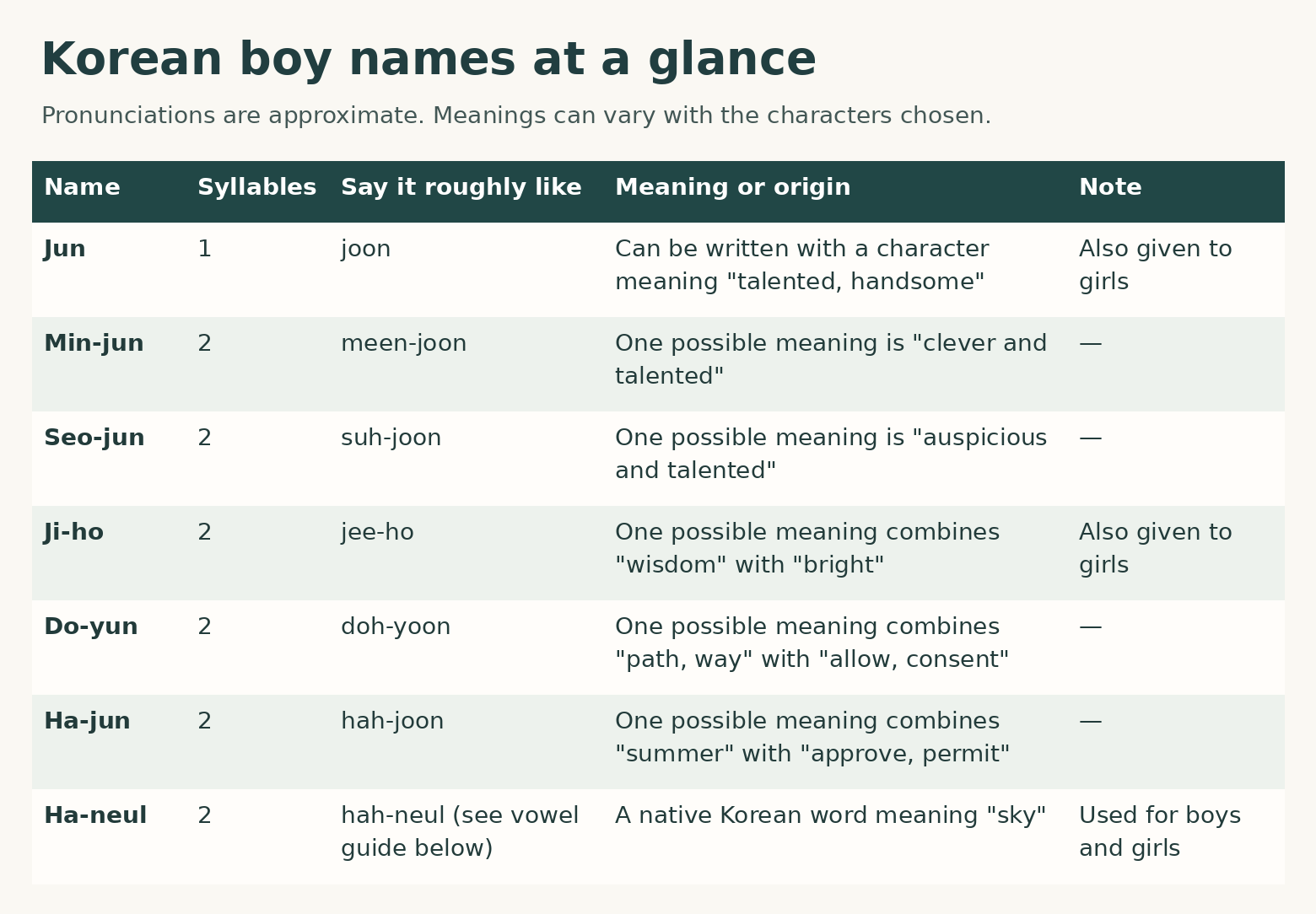
The phrase "one possible meaning" is deliberate. For names built from Chinese characters, the meaning depends on which characters a family chose, and the same sound can be written in several ways. The gender notes matter too: Jun and Ji-ho are not exclusively male, and Ha-neul is used for both boys and girls, so the name by itself will not tell you whether someone is a man or a woman.
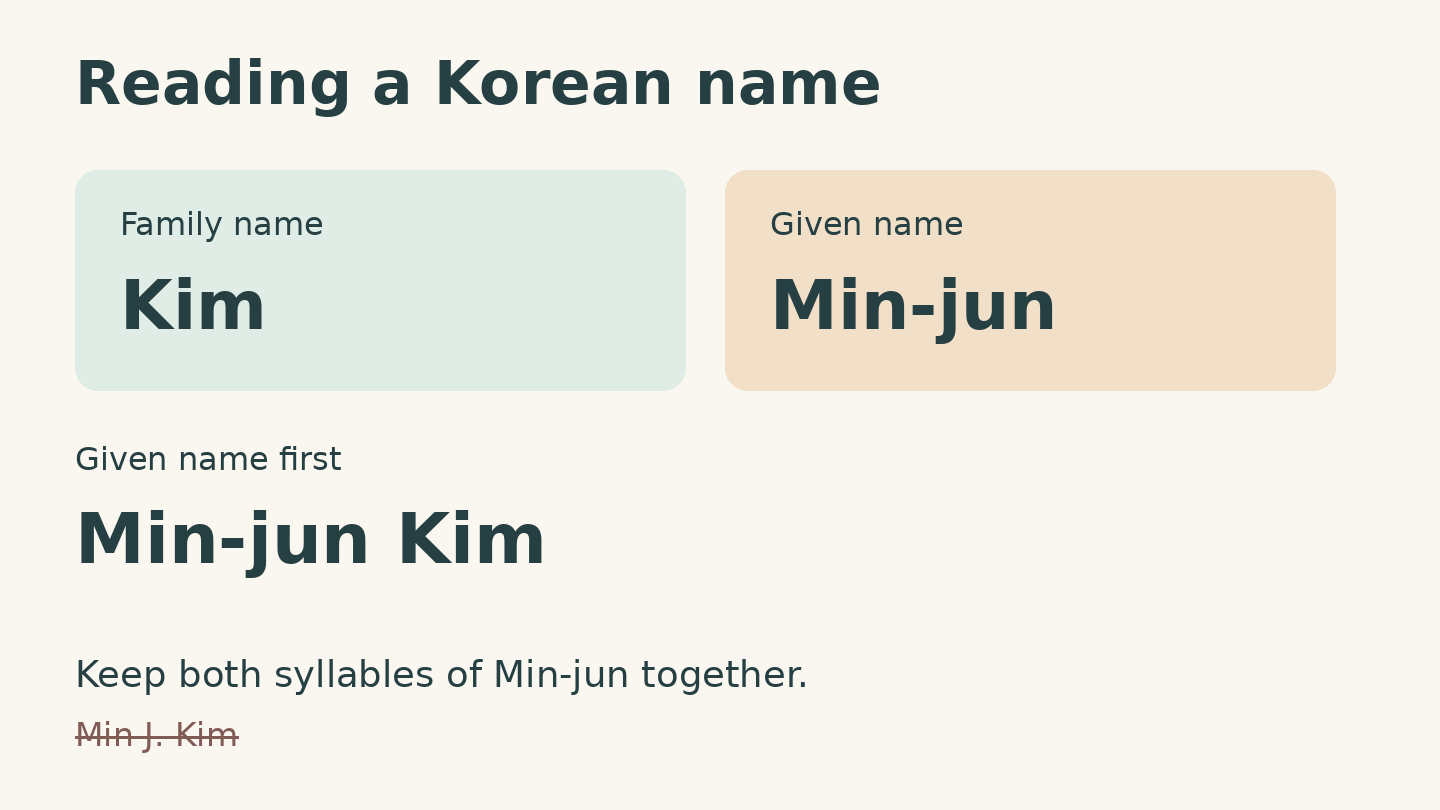
Kim Min-jun: which part is the first name?
Korean names put the family name first. In Kim Min-jun, Kim is the family name and Min-jun, the whole of it, is the given name. The two syllables belong together in the way the two halves of "Annabelle" do. The jun after the hyphen is not a middle name.
The distinction matters most on American forms and email signatures. In Western order he is Min-jun Kim, not Min J. Kim. If the hyphen is dropped he becomes Minjun Kim, which is still the same name. Shortening him to "Min" turns his name into a nickname, and that is his choice to make rather than a safe default.
One syllable or two
Two-syllable names like Ji-ho are the shape you will meet most often in this guide, but one-syllable names are in real use as well. Jun is the clearest example: a single syllable. Ji-ho, by contrast, has two short syllables, "jee" and "ho," and sounds most natural when both get roughly equal weight instead of a heavy stress on one.
If you are weighing names partly by sound, say each candidate aloud together with the family name it will sit beside. A one-syllable given name produces a brisk, compact full name; a two-syllable name gives it a longer rhythm. Neither is more traditional or more correct than the other.
How to say Seo-jun
The letters "eo" trip up nearly everyone at first. In the romanization system South Korea adopted in 2000, eo stands for a single Korean vowel, not two separate sounds. It is close to the "u" in "cup." Broken into syllables, Seo-jun reads like this:
1. Seo: "suh," one short syllable2. jun: "joon," rhyming with "moon"
Two more spellings are worth knowing. The "i" in Min and Ji-ho is closer to the vowel in "see" than to the one in "sit," so Min sounds more like "meen." The "eu" in Ha-neul has no exact English match; it is something like "oo" said with the lips spread rather than rounded. As with everything in the table, these respellings point toward the Korean sound without fully capturing it.
Why the same name can mean different things
Most of the names in this guide are Sino-Korean. Each syllable corresponds to a Chinese character, and the family chooses which character to use. Two families can both name their sons Min-jun and intend quite different things.
Min-jun shows this clearly. The jun can be a character meaning "talented" or "handsome." For min, one family might choose a character meaning "quick, clever," while another chooses one meaning "gentle, affable." One possible meaning of Min-jun is therefore "clever and talented"; another is "gentle and talented." The name sounds exactly the same in both cases, and other character combinations are possible as well.
This is the main reason to be cautious with name lists that assign a single fixed meaning to each name without saying which characters that meaning assumes. If you want to know what a particular person's name means, the useful question is which characters were chosen for it.
Names that come from Korean words
A smaller group of names comes straight from native Korean vocabulary, with no Chinese characters involved. Ha-neul is the ordinary Korean word for "sky," and the name means what the word means. There are no characters to choose, so the meaning does not shift from one family to the next.
The difference in how the two kinds of names are read is worth keeping in mind. A Sino-Korean name such as Min-jun is interpreted syllable by syllable, with each piece contributing part of the meaning. A native Korean name such as Ha-neul is read as one whole word, and splitting it into "ha" and "neul" would not produce two meanings.
Min-jun, Minjun, Min-joon: one name, several spellings
Look up a Korean name in English and you will find it spelled more than one way. Min-jun, Minjun, and Min-joon all refer to the same name. Seo-jun also appears as Seojun, Seo-joon, and Suh-jun. Under South Korea's official romanization rules, a given name is written as one word, as in Minjun, and a hyphen between syllables, as in Min-jun, is permitted. People may use established personal spellings such as Min-joon. When referring to someone, follow the spelling they use.
When searching for a name, try the joined form, the hyphenated form, and the "oo" version. They are one name rather than three candidates. This guide uses the hyphenated form throughout because the hyphen shows exactly where one syllable ends and the next begins, which is the information a first-time reader needs most