The Cittaslow (슬로시티) movement was founded in October 1999 by four Italian mayors who were tired of watching their small towns hollowed out by the same forces that had already transformed the cities. The founding charter, drawn up in the Umbrian hill town of Orvieto, proposed something that sounded almost naive: that a place could decide, formally and on record, to resist acceleration. No fast food chains. No large supermarkets flattening local producers. Traffic reduced rather than expanded. Public spaces designed for lingering. The name is a portmanteau of the Italian "citta" (city) and the English "slow," which gives you a sense of how seriously the founders took their global ambitions from the start.
By 2007, the network had spread to Germany, Norway, the United Kingdom, and Australia. Then, in December of that year, it crossed into Asia for the first time. Six Korean towns received certification simultaneously, and the island of Cheongsando (청산도), a 33-square-kilometer place reachable only by ferry from the port town of Wando in South Jeolla Province, became the first Slow City in Asia. The designation was not honorary. It came with criteria: measurable commitments to environmental policy, sustainable infrastructure, local food production, and the preservation of what the charter calls "the quality of urban life." For an island that had been shaped by its own difficulty for centuries, the certification was less a change of direction than a formal recognition of what it had always been doing.
What the island already knew about the slow approach
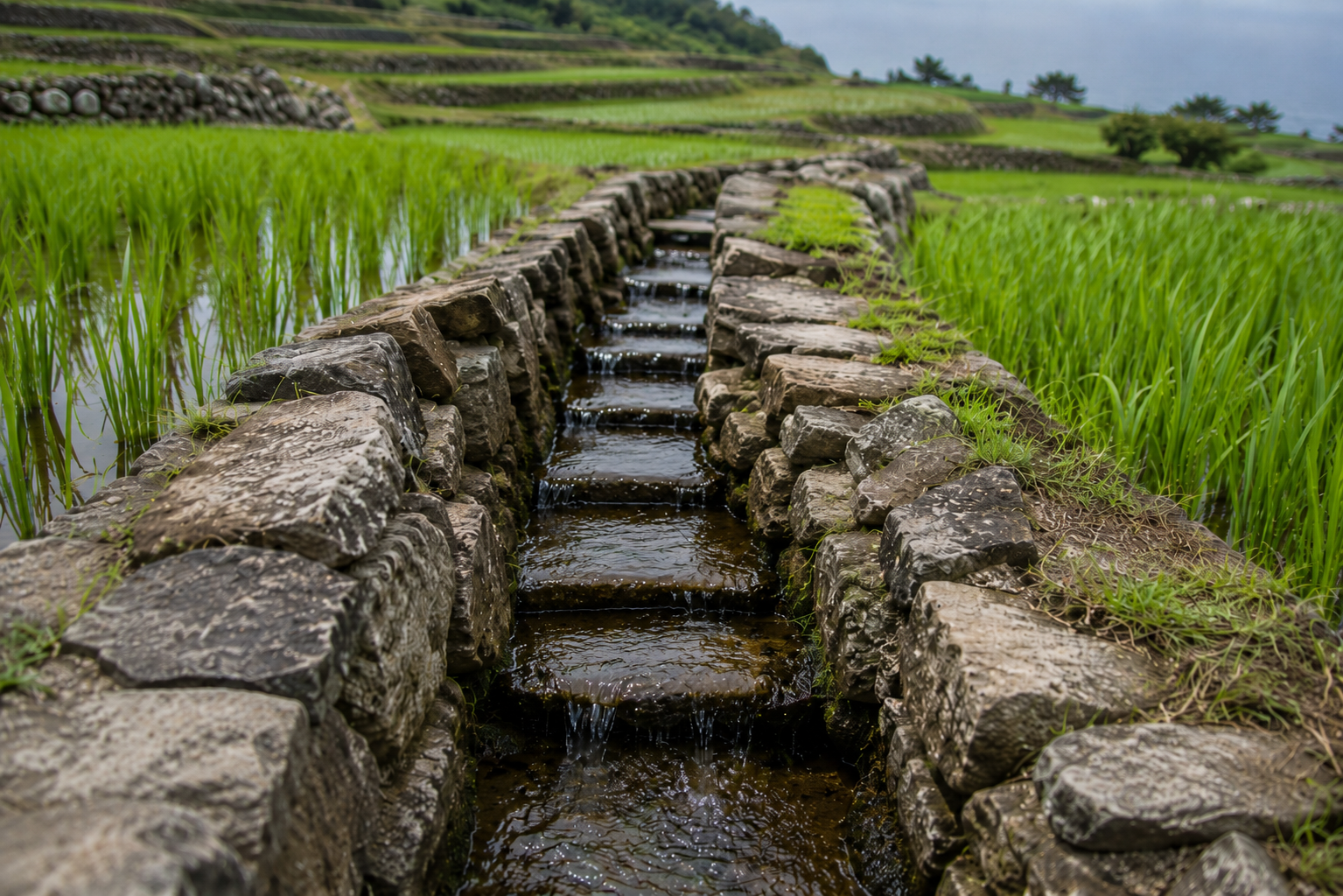
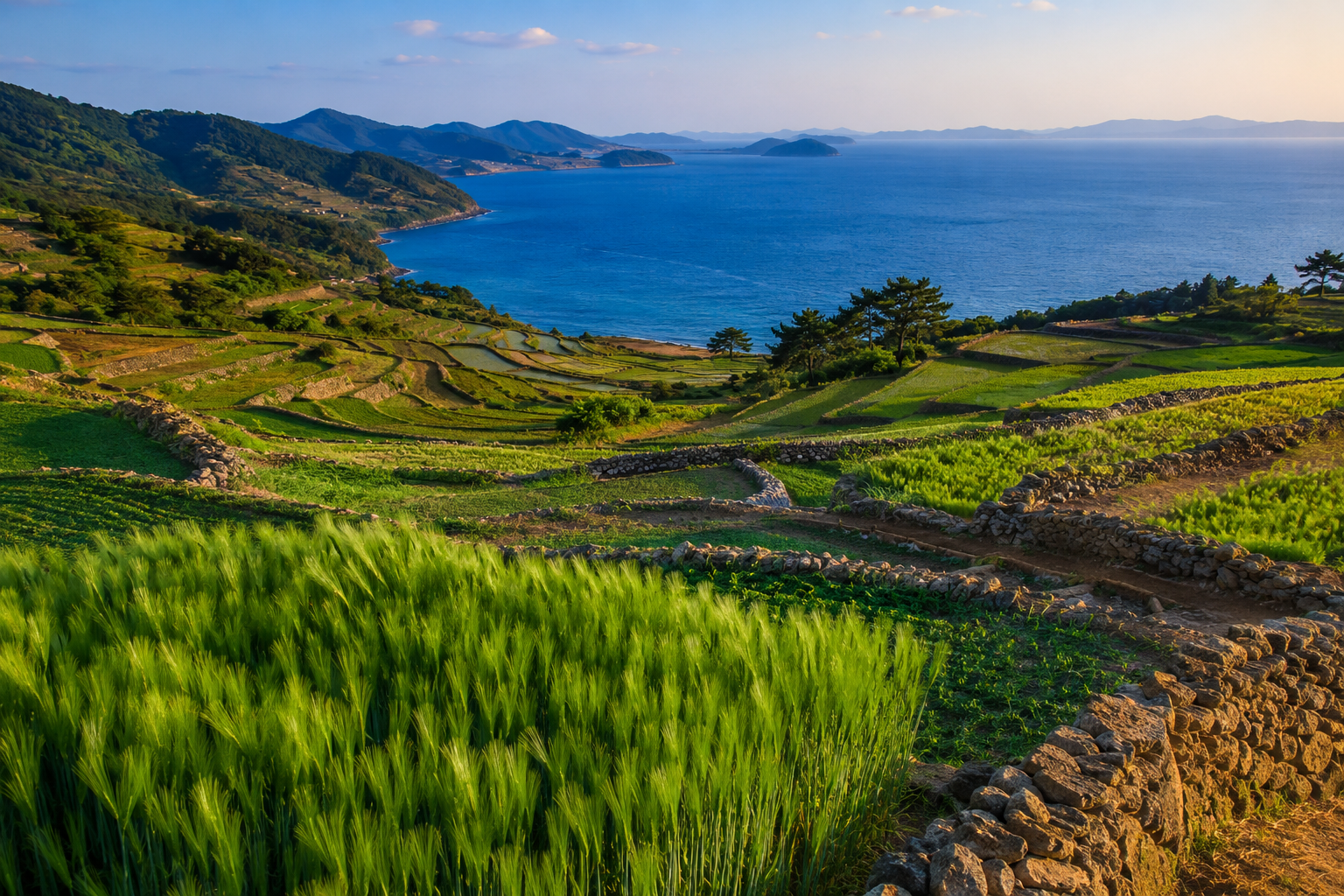
The name Cheongsando comes from the Chinese characters for "blue" (青) and "mountain" (山), a reference to the fact that the mountains, the sky, and the sea all appear in the same shade of deep color from the island's hills. The island sits 19.2 kilometers off Wando and looks toward Jeju Island to the south. What it has never had is easy agricultural land. The topography is steep, the soil rocky, the water drainage fast. Centuries of inhabiting this environment produced a singular solution: gudeuljangnon (구들장논), a system of underground stone irrigation channels that borrows its structural logic from the ondol (온돌) underfloor heating system used in traditional Korean homes. Flat stones are stacked beneath the rice paddies to slow drainage and redirect water, effectively creating viable watery fields on terrain where they should not exist. The system, which dates in its current form to at least the 16th century, was designated Korea's National Important Agricultural Heritage No. 1 in 2013, and is now listed by the UN's Food and Agriculture Organization as a Globally Important Agricultural Heritage System.
This is the deeper story behind the Slow City label: the island had already spent four hundred years developing a slow technology. Gudeuljangnon requires regular maintenance, collective management, and an intimate understanding of water behavior across seasons. It is the opposite of an efficient monoculture. It is, by almost any definition, a slow agricultural system that produces rice, barley, garlic, and onions in a place not designed to produce them. When the Cittaslow inspectors arrived in 2007, they were not discovering slowness. They were naming something that was already there.
The walking trail and what it reveals
In 2010, Cheongsando formalized its eleven Slow Walk courses (슬로길), totaling 42.195 kilometers, which is exactly the distance of a marathon. The trails were originally paths connecting villages, routes that residents used simply to get from one part of the island to another. They acquired the name "slow roads" because visitors, confronted with the views of the terraced fields, the stone walls, the canola blossoms in April and the barley rippling green in the same wind, kept finding themselves unable to walk at normal speed. In 2011, Cittaslow International designated the Cheongsando trail network as World Slow Walk No. 1.
Course 1 passes through Dangnak-ri (당락리), where the director Im Kwon-taek (임권택) filmed "Seopyeonje" (서편제) in 1993, the film about a pansori (판소리) singer's journey through the southern Korean countryside that became the first Korean film to sell more than a million tickets in Seoul. That connection matters not just as trivia. Pansori is itself a form of slow music: long, modal, built on endurance and accumulated feeling rather than resolution. The fact that Cheongsando's most famous cultural association is with this particular film is, to use the professorial register, not a coincidence.
Along the trails, one of the more distinctive features is the "slow postbox" (슬로우 우체통), a red mailbox that holds letters deposited by visitors and delivers them one year later. The postbox is a small, deliberate object lesson in the difference between communication and connection: it asks the sender to write something worth receiving a year from now, which is a different kind of attention from what most of us currently apply to our messages.
The tension the label brought with it
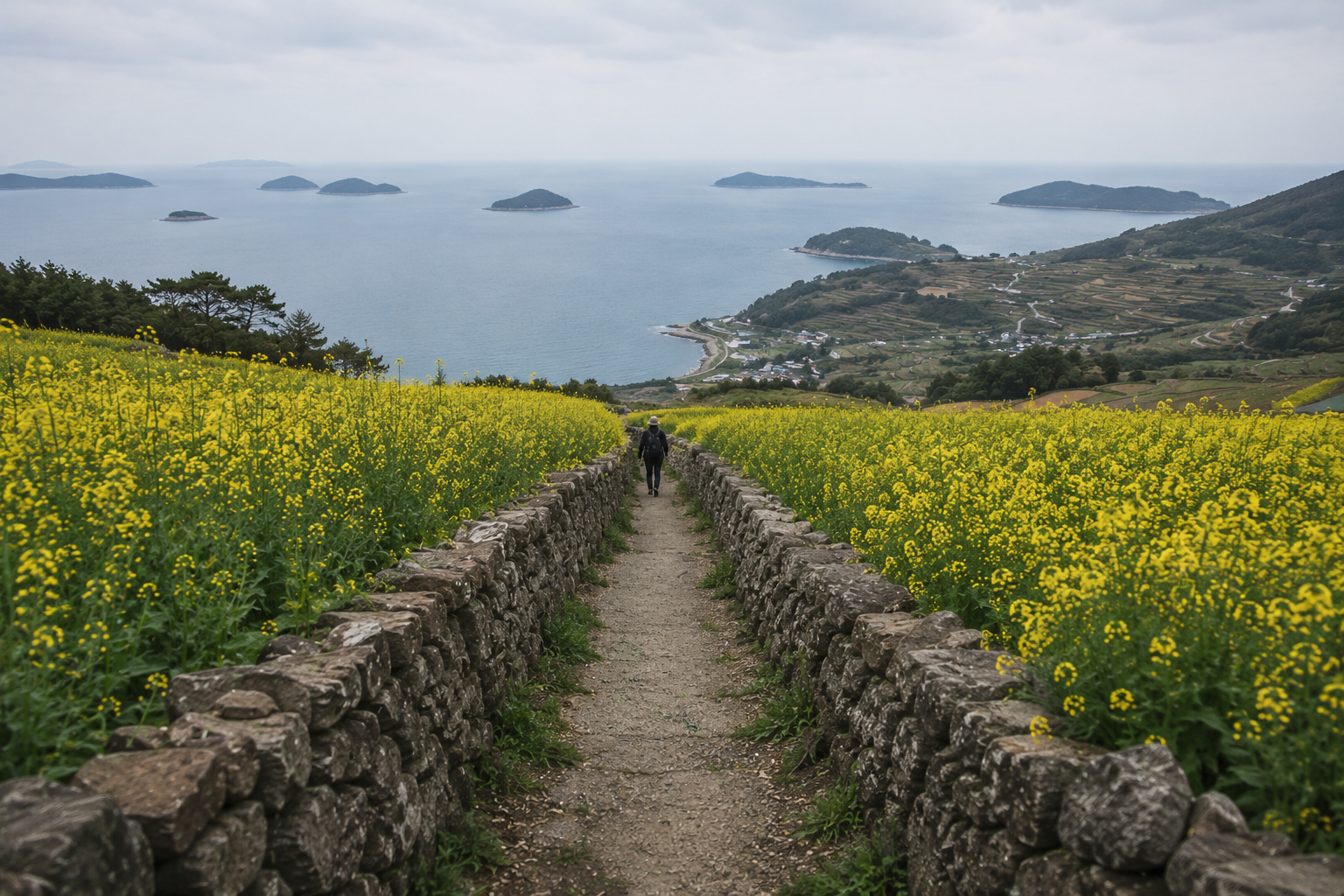
Receiving a Cittaslow designation is not purely a form of preservation. It is also a form of marketing, and the two are not always compatible. Tourism to Cheongsando increased substantially after 2007. The annual Slow Walking Festival, held each April when the canola and barley are at their most photogenic, draws visitors from across Korea and from abroad. Accommodation demand grew. Property values changed. Some scholars who visited afterward pointed out that a growing number of buildings on the island were modern residential structures with no particular historical character, which put the island in a peculiar position: technically a Slow City, visually a complicated mix of the genuinely old and the recently built.
This is a problem common to the entire Cittaslow network, not unique to Cheongsando. The movement's founding charter recognized it implicitly by distinguishing between towns that were slow by condition and towns that were merely performing slowness for visitors. The criteria are designed to measure actual policy commitments rather than aesthetic outcomes, which is why a town can pass the assessment without looking like a film set. But the tension between genuine rural preservation and sustainable tourism remains unresolved, not just on Cheongsando but in every Cittaslow community that has discovered what certification is worth on a travel itinerary.
What Cheongsando has that many slow cities do not is a pre-existing infrastructure of slowness that was not built for visitors. The gudeuljangnon paddies were not installed for tourism. The village paths were not designed to be photogenic. The ferry connection, which takes approximately 45 minutes from Wando and runs on a schedule that cannot be rushed, was not engineered as an experience. It was simply the way the island worked before anyone thought to call it slow. That underlying reality is what the Cittaslow designation was, at its most useful, pointing to: a place that had solved its hardest problems through patience and collective knowledge rather than acceleration. Whether the island can hold onto that distinction as the visitor numbers climb is the question the next decade will answer.