
Morning or night, empty stomach or with food? Here is what the research says about collagen timing, why consistency beats the clock, and how Korea's inner beauty routines fit collagen into everyday life.
No time of day has been shown to make collagen work better. If you are asking when is the best time to take collagen, the most defensible answer is the time you will actually stick with, every day. The skin and joint trials behind collagen share one design feature: daily use over weeks or months, not a precisely timed dose. That is why consistency, not the clock, is the variable worth managing.

Is It Better to Take Collagen in the Morning or at Night?
The morning argument usually rests on absorption: an empty stomach, the thinking goes, lets more collagen through. The night argument rests on repair: skin does much of its renewal while you sleep, so a bedtime dose should arrive just in time. Both sound reasonable, and neither has been tested in a way that settles the question.
What has been measured is how long collagen fragments stay in circulation. After people take hydrolyzed collagen, small peptides such as prolyl-hydroxyproline (Pro-Hyp) rise in the blood, peak roughly one to two hours later, and return to baseline within a day. A window that short is not synchronized with anything in particular; the body receives a fresh supply each day regardless of when it arrives.
So the practical choice is about habit. Morning works if collagen can ride along with something you already do, like coffee or a smoothie. Evening suits people whose mornings are unpredictable. If you plan to take a flavored powder or drink before bed, check the label for added sugar or coffee and tea flavors that carry caffeine.
Should You Take Collagen on an Empty Stomach?
The empty-stomach advice is common, and some of the classic absorption studies may have helped it along: volunteers were given collagen after an overnight fast, because that keeps blood measurements clean. That is a laboratory convenience, not a comparison showing that fasting improves results. Collagen is a protein, and the body breaks it down into amino acids and short peptides whether or not other food is present. Hydrolyzed collagen, usually sold as collagen peptides, simply arrives with part of that work already done.
Where the stomach does matter is comfort. Some people find a protein drink before breakfast unsettling; others like it precisely because it is quick. Neither choice has been shown to change what collagen does over time, so let your digestion and your schedule decide. If you take medications at fixed times around meals, a pharmacist can tell you whether spacing matters for those.
How to Take Collagen for Your Daily Routine
The format you choose largely decides how easy the habit is to keep.
- Powder: stirs into coffee, tea, smoothies or oatmeal. It is the most flexible option and often packs the largest amount per serving.
- Ready-to-drink bottles and shots: nothing to mix, which helps on hectic days.
- Jelly sticks: single-serve pouches eaten straight from the pack, no water needed.
- Capsules and tablets: tasteless and portable, though a multi-gram dose can mean several of them.
- Gummies: easy to remember, but check how much collagen each piece actually provides, and how much sugar comes with it.
Whatever the format, follow the serving size on your specific product. Doses in published studies vary widely, from about a gram a day of certain specialized peptides to 10 grams or more of standard collagen powder, and an amount used in one study does not automatically carry over to a different product.
The body needs vitamin C to make its own collagen; it is required in the chemical steps that build new collagen fibers. That is not the same as helping a supplement get absorbed, and there is no good evidence that it does. In one frequently cited study, eight young men who drank vitamin C-enriched gelatin an hour before skipping rope showed higher markers of collagen production, but every drink in the study contained vitamin C, so its own contribution could not be separated out. The sensible takeaway is to get enough vitamin C across the day, from citrus, kiwi, bell peppers, strawberries or broccoli, without timing it to the minute. The Daily Value for adults is 90 milligrams, and a medium orange provides about 70.
How Does Collagen Fit Into Korean Inner Beauty?
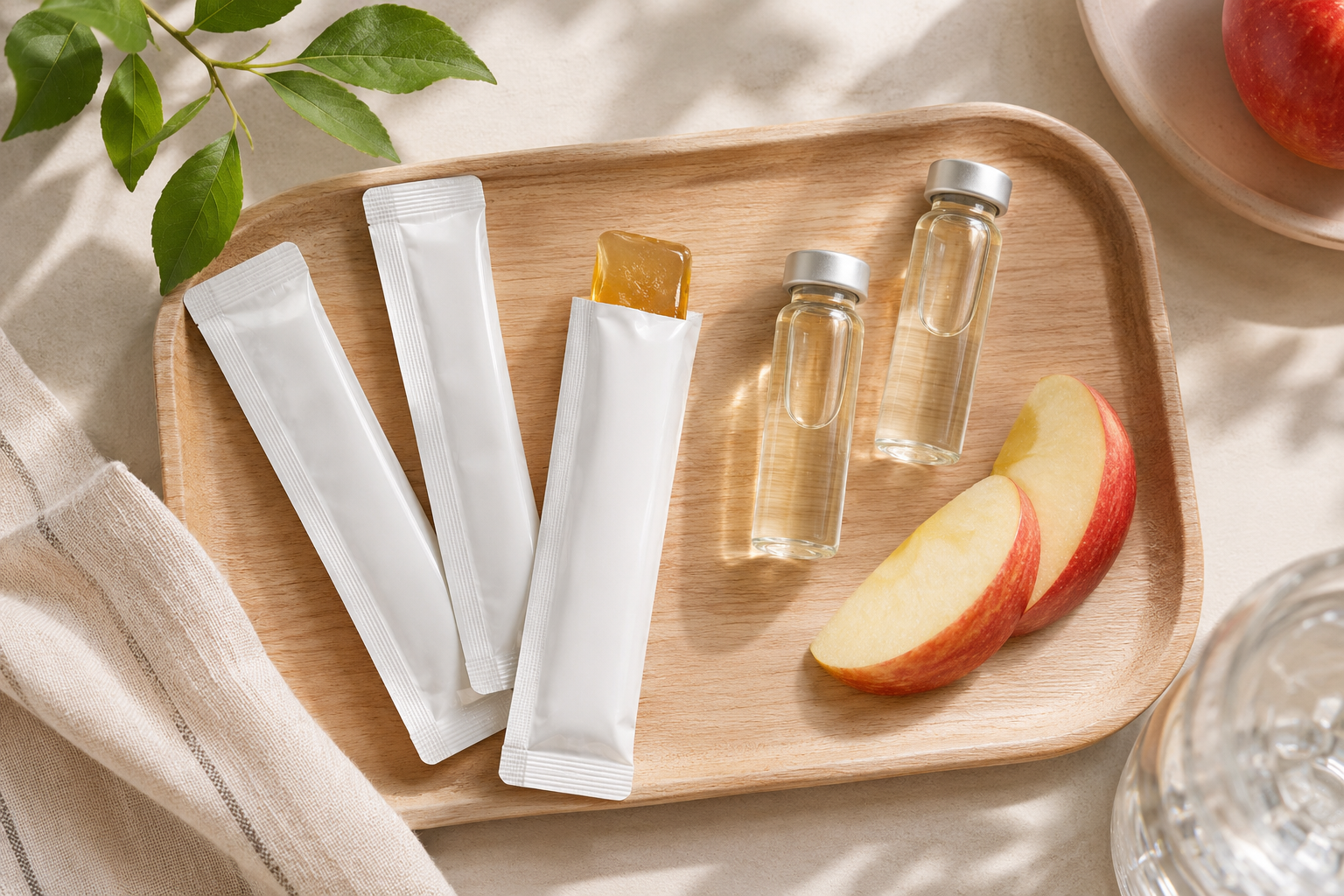
In Korea, the idea that skin care starts with what you eat has a name borrowed straight from English: inner beauty, written 이너뷰티 (ineo byuti). Collagen is one of its anchor ingredients, and the products are designed to slip into a day. Stick pouches of jelly are eaten without water, small drinkable ampoules sometimes come packaged with tablets, and fruit flavors such as apple are added partly to soften the taste of fish-derived collagen.
What stands out is how carefully the claims are worded. For a collagen ingredient to carry a skin claim on a Korean health functional food label, it goes through an individual review by the Ministry of Food and Drug Safety, based on human-study data. The approved language is restrained, along the lines of "may help with skin moisture" or "may help maintain skin health against UV damage." Each reviewed ingredient also comes with its own daily amount, which is why two Korean collagen products can list very different serving sizes. None of this makes Korean collagen more effective than collagen made elsewhere. It means the label is tied to the specific ingredient that was studied.
Inner beauty sits alongside topical skin care rather than replacing it, and the two work differently. Collagen fibers are too large to pass through the outer layers of the skin, and research has not shown that smaller collagen peptides do much better. A collagen cream and a collagen drink do different jobs, and neither should be judged by the other's claims.
What to Know Before Taking Collagen
The research is more mixed than the marketing. A 2025 analysis of 23 randomized trials, covering 1,474 participants, found improvements in skin hydration, elasticity and wrinkles when all studies were pooled. When the authors looked only at higher-quality trials, or only at trials without industry funding, those benefits were no longer significant. Collagen industry groups have disputed parts of that analysis, including how some studies' funding was classified, so the debate continues. Joint studies have reported benefits too, but most collagen research is funded at least in part by companies with a stake in the result. A fair summary: collagen may help some people modestly, the effect is not guaranteed, and it does not erase wrinkles or stop skin aging.
The FDA does not approve dietary supplements for safety or effectiveness before they are sold, so the label is your main tool. A few things to check:
- The source. Collagen usually comes from cattle, pigs, chicken or fish, and many Korean products use fish skin or scales.
- Allergen statements. Fish is one of the nine major food allergens in the United States, so anyone with a fish allergy should read the "Contains" line closely.
- The amount of collagen per serving, not just the serving size.
- Added ingredients such as sweeteners, caffeine, biotin or hyaluronic acid, which change what you are actually taking.
- Independent testing, if the brand offers it.
Studies have not found notable side effects from collagen supplements, but long-term safety data are limited. If you are pregnant, managing a health condition or taking prescription medication, check with your doctor or pharmacist before adding one.
The Best Time Is the Time That Works for You
Pick a slot you already protect: the first coffee, the post-workout shake, the cup of tea after dinner. Keep it there. Most trials ran for about 8 to 12 weeks, so judge a product over a similar stretch rather than a few days, with the understanding that any change, if it comes, tends to be modest. The clock, it turns out, was never the part that mattered.