Appa is the everyday word for dad in Korean, and abeoji is closer to father. Here is how to choose between them, pronounce them, and use them in sentences like "My dad" and "Dad, I love you."
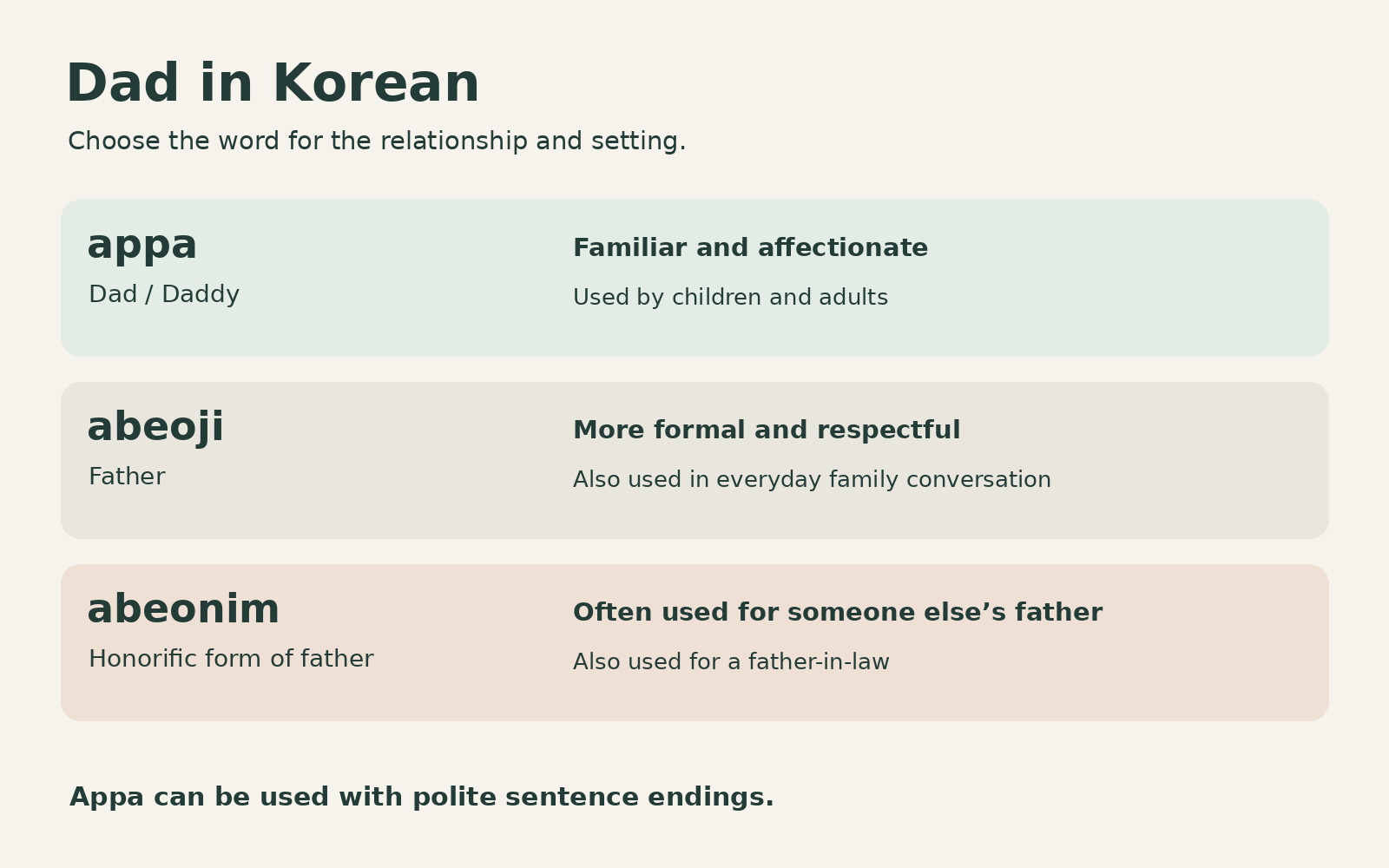
If you want to say dad in Korean, the word is appa. It sits close to the English "dad" or "daddy": warm and familiar, and a natural way to call out to your father at home. The more formal word is abeoji, which lines up with "father." Both refer to the same person. What changes is the tone.
That is the short answer. The longer one is about how Koreans actually choose between the two, because the choice is not quite the one most learners expect.
Appa or abeoji: closeness matters more than age
A common assumption is that appa belongs to small children and that everyone switches to abeoji at some point in adulthood. Some people do make that switch; others continue using appa as adults. In a family that has always used appa, keeping that familiar form can feel natural. You do not have to stop using it at a particular age, although abeoji is generally more appropriate on formal occasions.
So the real deciding factors are the habits of the family and how close parent and child feel. In one household, abeoji is the everyday word because the father spoke to his own father that way and the children picked it up. In another, appa has simply never stopped feeling natural.
It also helps not to over-read abeoji. It is more formal than appa and carries a clear note of respect, but formal does not mean cold. A son who calls his father abeoji may be every bit as close to him as a daughter who says appa. Abeoji is generally a suitable choice in formal settings, such as a wedding speech or a formal introduction.
How to pronounce appa and abeoji
The romanized spellings and English-style guides below are approximations. Korean has sounds English does not, so treat these as a starting point and listen to a native speaker when you can.
appa: roughly "ah-ppah." The pp is a tense consonant, a sound English does not really have. Press your lips together firmly, build a little pressure, and release it crisply, without the puff of air you would put on the p in "pop." It should sound tighter and stronger than an ordinary p, and never soft enough to drift toward "ah-bah."
abeoji: roughly "ah-buh-jee," three syllables, a-beo-ji. The eo in the middle is a single vowel, close to the "uh" in "sun." It is not an "e" followed by an "o," so avoid saying "ah-beh-oh-jee."
Talking to your dad vs. talking about him
English uses "Dad" both when you call your father and when you mention him to someone else. Korean works much the same way, with one extra word worth learning for the second case.
When you are speaking to your father
Appa, saranghae. Dad, I love you.
Appa, saranghaeyo. Dad, I love you. (with a polite ending)
Appa, eodiseyo? Dad, where are you?
Abeoji, siksahasyeosseoyo? Father, have you eaten?
Look at the second and third lines. The word you use to address your father and the politeness of the sentence ending are two separate choices. Appa sits comfortably in front of a polite -yo ending or an honorific form such as -seyo, and many adults speak to their fathers exactly this way: the familiar word up front, polite grammar behind it. Appa does not force casual speech, and choosing it says nothing about whether you are being respectful.
When you are talking about your father
To say "my dad," a common Korean expression is uri appa or uri abeoji. Uri can mean "we" or "our," but with a family member it can refer to someone close to the speaker. When you are telling someone about your own dad, uri appa usually means "my dad," even if you are an only child. If siblings are talking about their shared father, "our dad" can be the right translation. Context decides.
Uri appaneun yorireul jalhaeyo. My dad is a really good cook.
Ijjogeun uri abeojiyeyo. This is my father.
That said, nae appa and je abeoji, the more literal "my dad" and a humble "my father," are not mistakes. Nae appa can emphasize whose dad you mean, while je abeoji is useful in polite speech. Je makes the reference to yourself humble; it does not lower your father. For example: Je abeojineun Busane saseyo, "My father lives in Busan." Uri appa is a useful everyday expression to learn alongside them.
Where abeonim fits
Abeonim is an honorific form of abeoji. Learn it as a separate word rather than simply attaching -nim to the full word abeoji. Its main job is showing respect for someone else's father, as in Abeonimeun jal jinaeseyo?, "How is your father doing?" It is also the word a married woman typically uses to address her husband's father.
Because it is so elevated, abeonim is not a stronger version of "dad" for everyday use. Traditional etiquette guidance generally favors abeoji for your own living father in conversation; abeonim also appears in letters and other special contexts. Family preferences can vary. For your own father, appa and abeoji are the pair to know.
Appa is not oppa
One more mix-up comes up often among learners. Oppa sounds similar but is an entirely different word: it is what a woman calls her older brother, or a close older man such as a friend or boyfriend. It does not mean dad. The first vowel distinguishes the two: a in appa and o in oppa. The Korean o is a steady vowel, so avoid exaggerating the glide in English "oh." Practicing them side by side can help.
Whichever word a family settles on, what follows it tends to matter more. Appa with a polite ending and abeoji said with warmth are both ordinary Korean, and both can carry exactly the same affection.