A one-quart napa cabbage kimchi recipe for beginners, with U.S. ingredient swaps, clear salting and fermenting steps, fridge-safety tips, and a short look at kimjang, Korea's winter kimchi-making tradition.
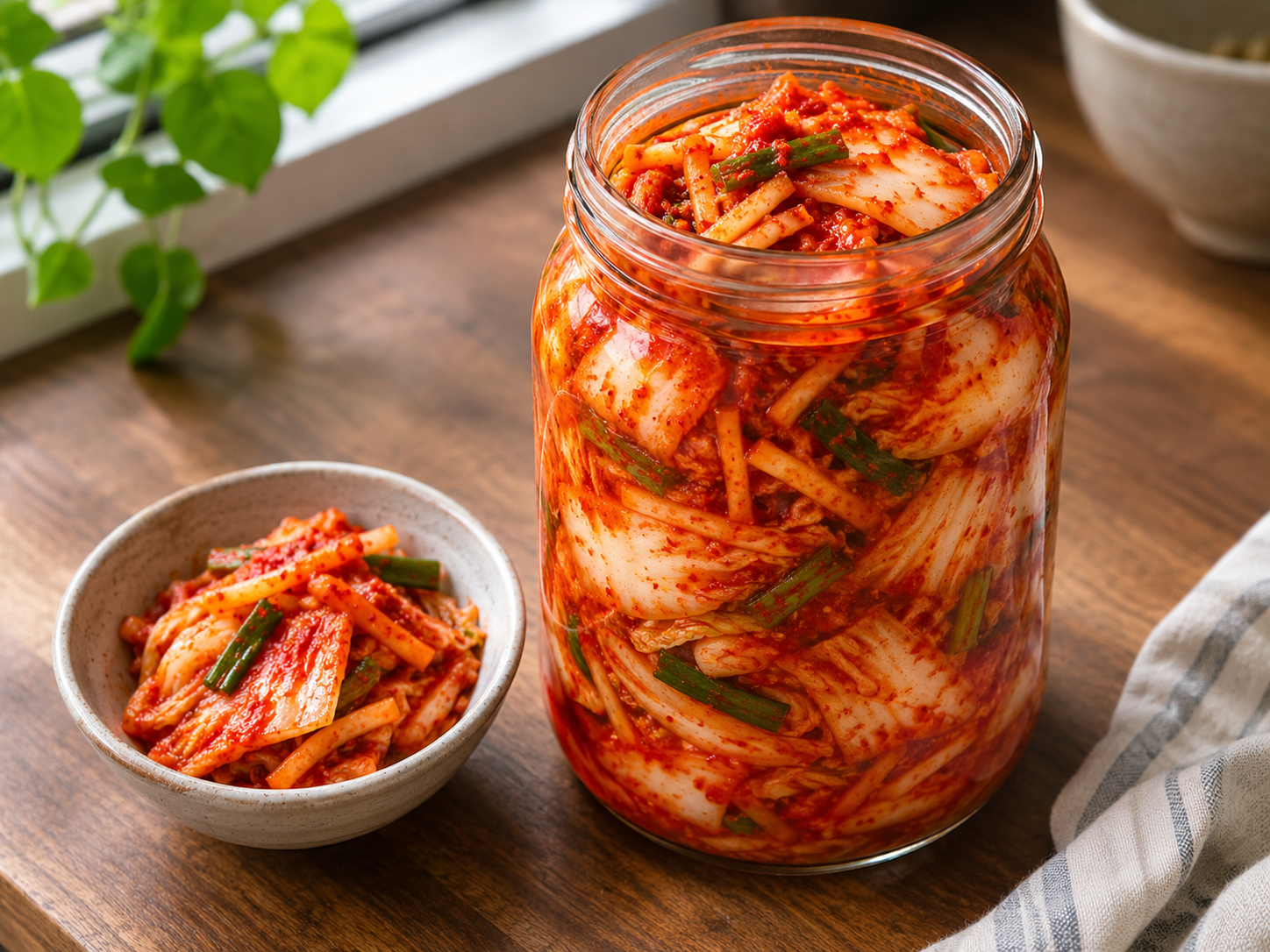
Learning how to make kimchi at home comes down to four moves: salt napa cabbage until it bends without snapping, stir together a paste of garlic, ginger, fish sauce and gochugaru (Korean red pepper flakes), work the two together, then let the jar ferment at room temperature for a day or two before it goes into the fridge. The recipe below makes about one quart from a single medium head of cabbage. Plan on roughly an hour of hands-on work, about two hours of salting, and a few more days of waiting before the flavor settles.
This is mak-kimchi (막김치), the cut-up version of baechu-kimchi (배추김치, napa cabbage kimchi). The more traditional whole-leaf style, pogi-kimchi, uses similar seasonings but takes longer, because the cabbage is salted in halves and the paste is spread leaf by leaf. For a first batch, cut pieces are easier to salt evenly and easier to judge. Geotjeori, a fresh kimchi eaten without fermenting, and kkakdugi, made from cubed radish, follow different methods and are not covered here.
Kimchi at a glance
- Makes: about 1 quart (roughly 8 side-dish servings)
- Hands-on time: 45 to 60 minutes
- Salting and draining: about 2 hours
- Room-temperature fermentation: 1 to 2 days, then refrigerate
- Best flavor: after several more days in the fridge
Ingredients
- 1 medium head napa cabbage, about 2 pounds (900 g)
- 1/4 cup non-iodized salt, such as kosher, sea or pickling salt
- Cool water, enough to cover the cabbage
- 1 tablespoon finely grated or minced garlic (5 to 6 cloves)
- 1/2 to 1 teaspoon grated fresh ginger
- 1 teaspoon sugar
- 1 1/2 to 2 tablespoons Korean fish sauce, or fish sauce mixed with a little minced saeujeot (salted shrimp)
- 2 to 5 tablespoons gochugaru, depending on how much heat you want
- 4 to 8 ounces (115 to 225 g) Korean radish or daikon, peeled and cut into thin matchsticks
- 4 scallions, cut into 1-inch pieces
- Food-safe gloves, a large bowl and a clean 1-quart glass jar
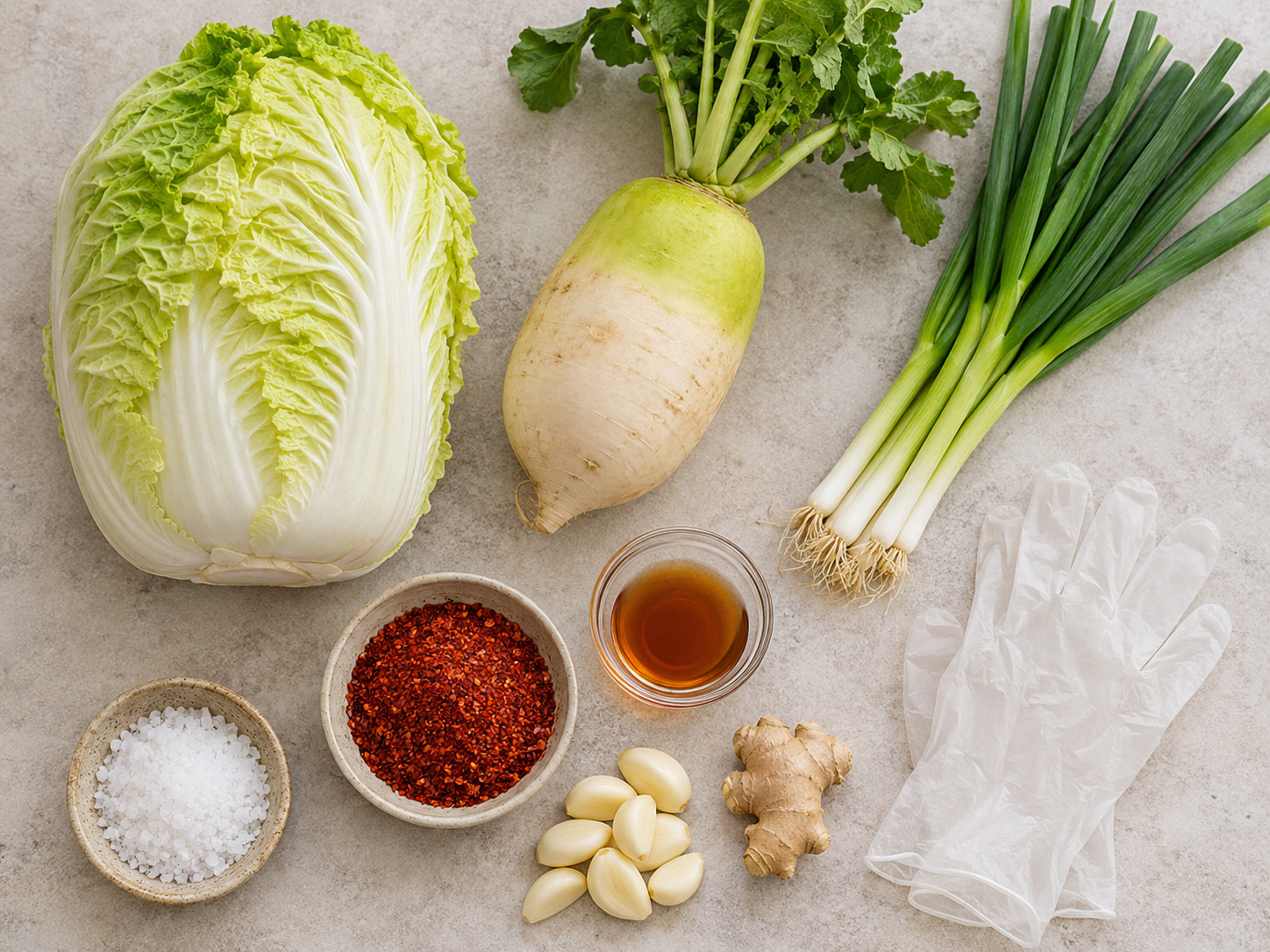
Finding the ingredients in the U.S.
Napa cabbage is the easy part. Most large American supermarkets carry it, sometimes labeled Chinese cabbage, and Korean and other Asian grocery stores stock it year-round. Look for a tight, heavy head with crisp white ribs. Green or savoy cabbage will ferment, but the texture and flavor are different enough that you end up with a kimchi-style pickle rather than baechu-kimchi.
Gochugaru decides more about the finished kimchi than any other ingredient, from its color to its heat. It is sold as coarse flakes, the usual choice for kimchi, and as a finer powder. It is fairly mild compared with cayenne. Some cooks who cannot find it use a mix of hot paprika and dried chili flakes; that works as a fermented cabbage, but the color, heat and flavor will not match, so add any substitute a little at a time and taste as you go.
Fish sauce supplies the savory depth. Korean fish sauce, most often made from anchovies (myeolchi-aekjeot), is the closest match. Thai and Vietnamese fish sauces are easier to find in regular supermarkets and some home cooks use them with good results, but they taste different, so start with the lower amount. Saeujeot, tiny salted shrimp sold in jars in the refrigerated or freezer section of Korean markets, is optional. For a vegetarian batch, swap in soy sauce or a vegan fish sauce; the kimchi will still ferment, though it will taste lighter. If you are cooking for others, keep in mind that fish, shellfish and soy are all major food allergens.
Korean radish (mu) is shorter and denser than daikon, but daikon works well. Salt matters more than most beginners expect. Choose salt without iodine or anti-caking agents, which many cooks avoid for fermenting. Crystal size also varies by brand, so a quarter cup of one salt can be noticeably saltier than another. That is why the steps below rely on touch and taste, not the clock alone.
Step by step
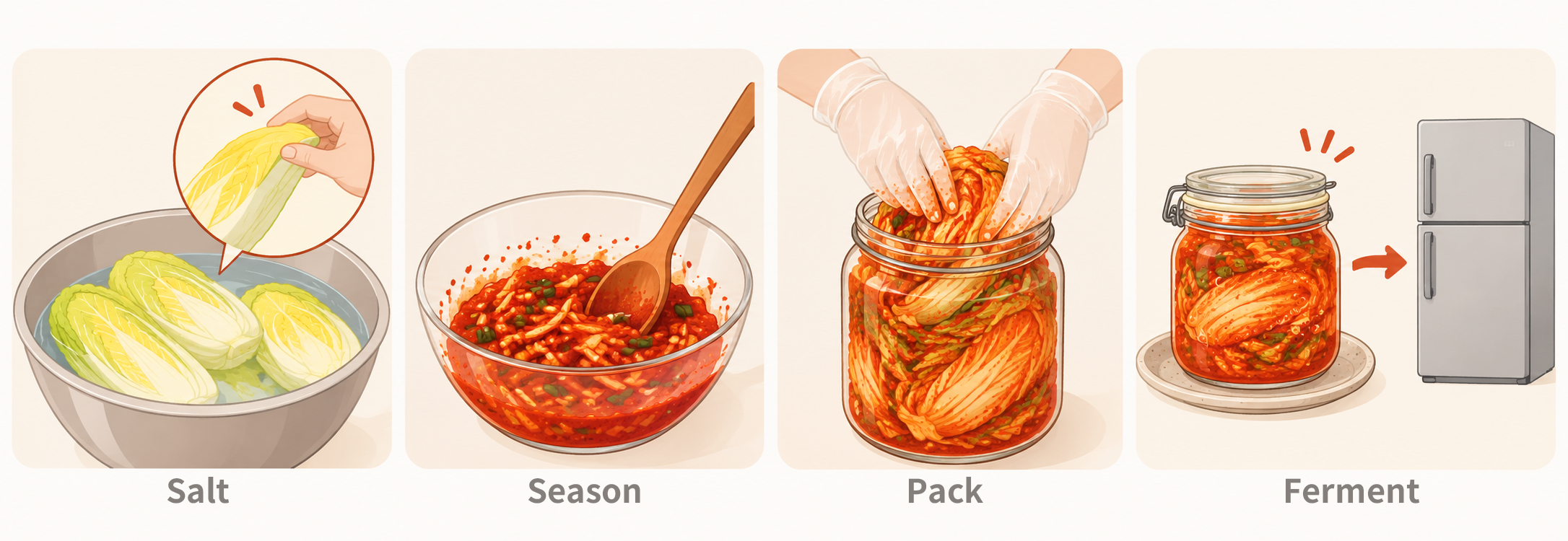
Step 1: Salt the cabbage
Wash your hands well, and wash your bowl, knife, cutting board and jar in hot, soapy water. Cut the cabbage lengthwise into quarters, cut away the hard core, and slice each quarter crosswise into 2-inch pieces. Rinse and drain. In a large bowl, toss the cabbage with the salt and massage it in until the pieces begin to soften, then add enough cool water to cover. Set a plate on top and weigh it down with a heavy jar or can.
Leave it for 1 1/2 to 2 hours, turning the cabbage once or twice. It is ready when a thick white rib bends without snapping and a piece tastes clearly salty, like a good pickle rather than seawater. If the ribs still snap, give it another 20 to 30 minutes and check again.
Rinse the cabbage in cold water three times, then let it drain in a colander for 15 to 20 minutes while you make the paste.
Step 2: Make the seasoning paste
In a clean large bowl, stir the garlic, ginger, sugar and fish sauce together. Add the gochugaru, starting with 2 tablespoons if you are cautious about heat, and stir until you have a thick red paste. Taste a little. It should be strong and salty on its own, because the cabbage will mellow it.
Many traditional recipes also stir in a cooled porridge made from sweet rice flour and water, which helps the seasoning cling to the leaves. It is worth trying once you have a batch or two behind you, but this small, cut-cabbage version works without it.
Step 3: Mix and pack
Squeeze the excess water from the cabbage a handful at a time and add it to the bowl along with the radish and scallions. Put on gloves, since gochugaru stings and garlic lingers on skin, and work the paste into everything until every piece is evenly coated.
Pack the kimchi into the jar, pressing down firmly to push out air pockets until the liquid rises above the vegetables. Leave at least 1 inch of space at the top, because fermentation produces gas and pushes liquid upward.
Step 4: Ferment, then refrigerate
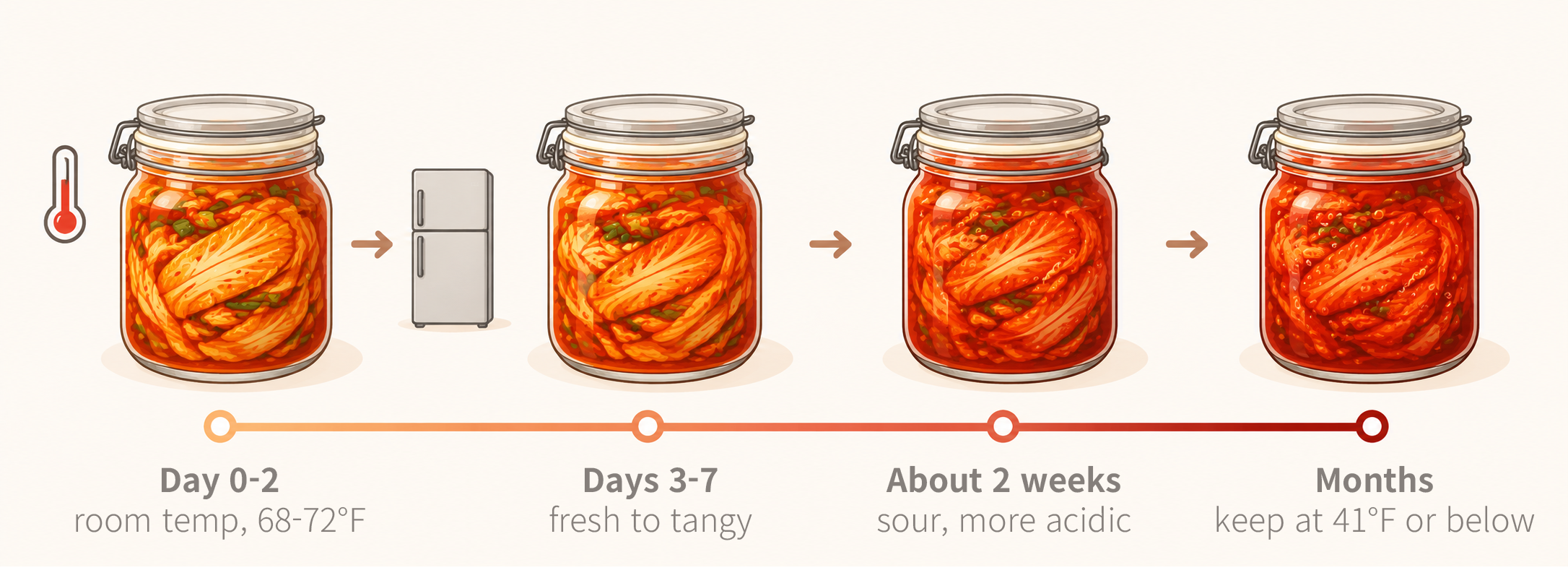
Cover the jar loosely and set it on a plate, out of direct sunlight. A room around 68 to 72°F is ideal. Below about 60°F the kimchi may barely ferment, and above about 75°F the cabbage can turn soft or spoil before it sours properly. Once a day, press the vegetables back under the liquid with a clean spoon and taste.
Within one to two days you should see small bubbles and notice a light sourness. That is your cue to close the lid and move the jar to a refrigerator set at 41°F or below. You can eat it right away, though the flavor rounds out over the next several days.
How the flavor changes, and how to keep it safe
Kimchi keeps fermenting in the fridge, only more slowly. For the first few days it tastes fresh, salty and crunchy, closer to a spicy salad. Over the first week or so it turns noticeably tangier, the aroma grows stronger and the cabbage softens. After about two weeks it typically becomes acidic enough to hold back most foodborne pathogens, and from there it simply keeps getting sourer. Very ripe, sour kimchi is not a failure. It is exactly what Korean cooks want for kimchi jjigae (kimchi stew) or kimchi fried rice.
A few habits keep a homemade batch safe and pleasant:
- Use a clean utensil every time you take kimchi out, then press what remains back under the liquid.
- Keep it cold, at 41°F or below, once the room-temperature stage is over.
- Expect bubbles and a sour, garlicky smell. Both are normal.
- Throw the batch out if you see mold, smell something rotten rather than sour, or find the cabbage slimy or mushy. These signs can point to a ferment that went wrong, so treat them as a safety issue, not just a matter of taste.
Stored cold and handled cleanly, homemade kimchi generally keeps for a few months, growing more sour as it ages.
Beginner mistakes worth avoiding
- Salting by the clock alone. Under-salted cabbage stays stiff, tastes flat and spoils more easily, while over-salted cabbage cannot be fixed later. Use the bend test, and taste a piece after rinsing. If it is still harsh, rinse once more.
- Skipping the drain. Wet cabbage dilutes the paste and gives you watery, bland kimchi.
- Starting with maximum heat. You can make the next batch spicier; you cannot take gochugaru back out of this one.
- Overloading on garlic and ginger. More is not always better, and both can crowd out the cabbage.
- Filling the jar to the brim. Fermenting kimchi expands, so leave headspace and keep a plate underneath.
Kimjang: why Korea makes kimchi together in winter
Kimjang (김장) is the late-autumn custom of making large batches of kimchi to last through winter. Relatives and neighbors would gather to salt cabbage and season it by hand, then share what they made so every household had enough before the cold set in. The preparation once ran through the year, with seafood salted in spring, sea salt bought in summer and red peppers dried and ground at summer's end. In 2013, UNESCO added kimjang, the making and sharing of kimchi in Korea, to its list of the Intangible Cultural Heritage of Humanity.
The practice has changed. Many families still gather in late autumn, often making smaller amounts or starting with pre-salted cabbage, while a growing share of Korean households now buy kimchi rather than make it. A one-quart batch in an American kitchen is, in that sense, not so far from how plenty of Koreans make kimchi today.
The tradition has even produced a fashion story. The kimjang vest (김장 조끼) is a padded, quilted vest, usually in loud floral prints, that older Korean women wore to keep warm through long kimjang days. For years it stood for everything unfashionable. In late 2025, after K-pop idols posted photos in similar vests, it turned into a retro winter trend among younger Koreans, and cheap versions climbed the rankings on shopping apps. It is everyday workwear rather than traditional dress, but if you ever salt cabbage on a cold porch, the logic holds.