

Kim, Lee, and Park cover about 45 percent of South Korean citizens. Here are 20 common Korean last names with Hangul, Hanja meanings, and spelling variants, plus what the bon-gwan says about family history.
The most common Korean last names are Kim (김), Lee (이), and Park (박). In South Korea’s 2015 census, the most recent one to count the population by surname, those three names together covered about 44.6 percent of South Korean citizens, and Kim alone accounted for roughly one person in five.
That concentration is usually the first thing people notice. The second takes a little longer: a Korean last name tells you less on its own than you might expect. Two people named Kim may share nothing beyond a character on a census form, and the same name can appear in English under three or four spellings. Below are the 20 most common Korean surnames, what their characters mean, why a few names came to dominate, and how to read the names you meet in K-pop credits and K-drama casts.
20 Common Korean Last Names and Their Meanings
Nearly every Korean surname has an underlying Hanja (한자), a Chinese character, and the meaning of a surname is really the meaning of that character. Two cautions apply. Some surnames are written with more than one Hanja, so a single Hangul spelling can carry different meanings in different families. And the literal meaning of the character says nothing about the person who carries it; a Hwang is not “yellow” in any sense that matters.
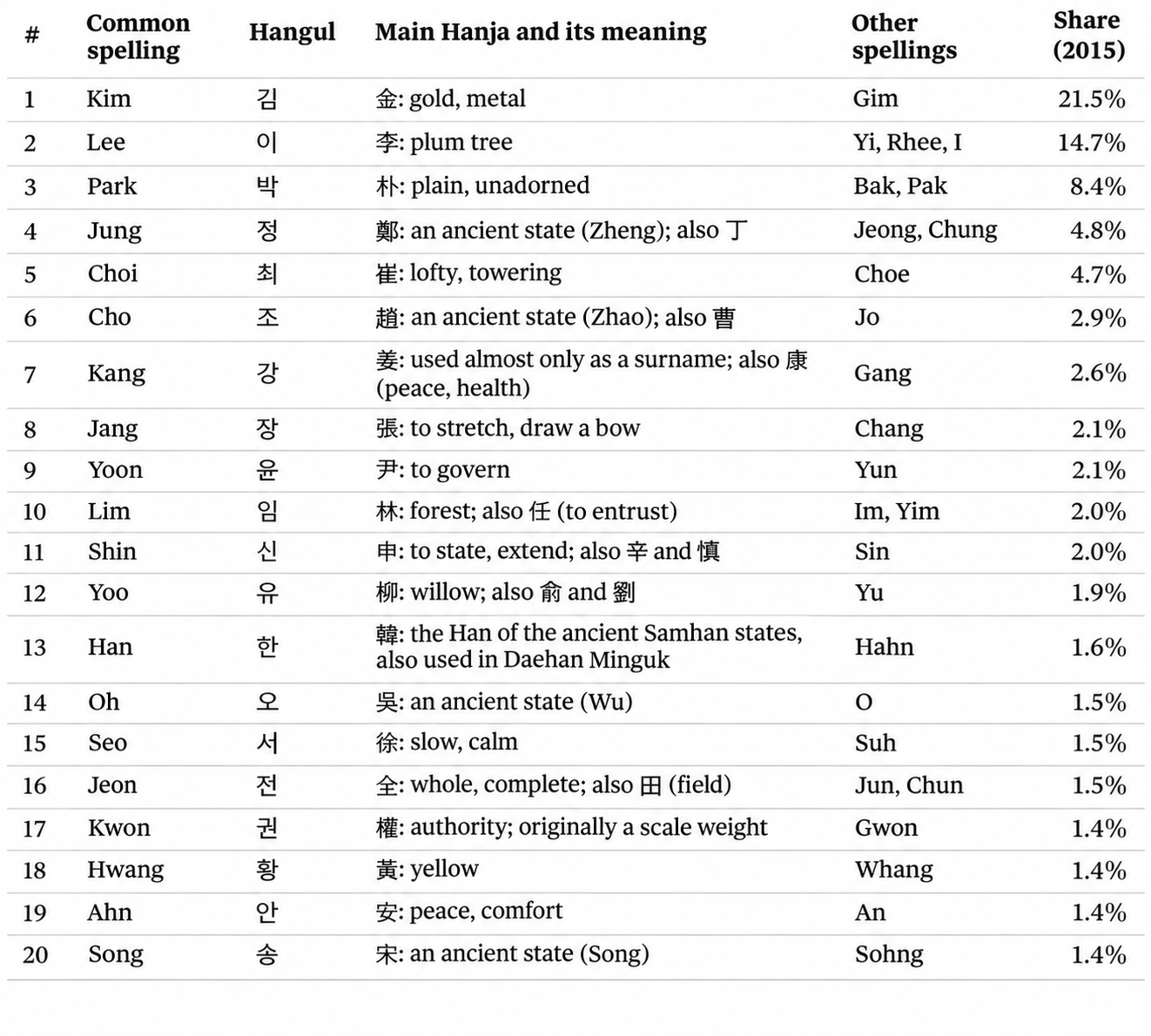
Ranks and shares group surnames by Hangul spelling, which is how they appear in English, using 2015 census figures for South Korean citizens. Lists that separate surnames by Hanja put Choi (崔) ahead of Jung (鄭), because the Hangul 정 combines several characters. The census also counts Ryu (류) apart from Yoo (유) and Rim (림) apart from Lim (임).
Why so many spellings? Most of these names were written in English long before South Korea adopted its current official system, the Revised Romanization of Korean, in 2000. Under that system 김 is Gim and 박 is Bak, but spellings like Kim and Park were already familiar, and most families kept them. Lee is a special case. The character 李 was historically read “ri,” and standard South Korean pronunciation drops the initial r, so the name is said “ee”; Lee, Yi, Rhee, and the rarer Rhie are all attempts to write that sound, while North Korea keeps Ri. Park, for its part, sounds closer to “bahk” than to the English word.
Park also comes with a story. The 12th-century history Samguk Sagi says that Bak Hyeokgeose, the legendary founder of Silla, hatched from an egg shaped like a gourd, and because the people of Jinhan called a gourd bak, that became his surname.
Why Are Kim, Lee, and Park So Common in Korea?
For most of Korean history, a surname was not something everyone had. In the Three Kingdoms period, surnames were used mainly by royal houses and a small elite, and they spread to the wider population only gradually over the following centuries. Household registers from the 1600s suggest that a large part of the population still had none.
The decisive change came in 1909, when the People’s Register Law (민적법, Minjeokbeop) required every household to record a surname and an ancestral seat. People who had never needed a surname now needed one on paper, and many took names that were already widespread. Historians commonly point to this late, rapid adoption, layered on centuries of slower spread, as one reason a handful of names grew so large.
The result is lopsided. The 2015 census counted 5,582 surnames, a total that keeps rising as naturalized citizens register new names, yet the 153 surnames with 1,000 or more bearers covered 99.8 percent of the population.
How Do Korean Names Work?
A Korean name puts the family name first. In 김지수, Kim is the surname and Ji-soo is the given name. Most surnames are one syllable and most given names are two, which is why so many Korean names have three syllables. A few surnames have two, such as Namgung (남궁) and Hwangbo (황보).
In English-language settings the order is often flipped to match Western habits, so Kim Ji-soo may introduce herself in the United States as Ji-soo Kim. When in doubt, the syllable that matches a surname in the table above is almost always the family name.
Stage names can hide the surname entirely. IU’s legal name is Lee Ji-eun, and BLACKPINK’s Rosé was born Park Chae-young. BTS offers a useful lesson in spelling: J-Hope is Jung Ho-seok (정호석) and Jungkook is Jeon Jung-kook (전정국). Their surnames are different, Jung and Jeon, and the “Jung” at the start of Jungkook’s given name is not his surname at all. Given names are chosen separately, so a syllable that sounds like a surname does not borrow the surname’s meaning.
What Do Korean Last Names Tell Us About Family History?
The surname is only half of a Korean family identity. The other half is the bon-gwan (본관), the ancestral seat: a place name attached to a clan, usually tied to where its founding ancestor is said to have lived. Gimhae Kim and Gyeongju Kim share a surname but are separate clans with separate founders, and families have long recorded their lines in genealogy books called jokbo (족보).

The 2015 census recorded 36,744 combinations of surname and bon-gwan. The largest single clan is the Gimhae Kim, at about 4.46 million people, roughly 9 percent of the population, followed by the Miryang Park at about 3.1 million and then the Jeonju Lee.
So two people with the same Korean last name are not necessarily relatives, and a clan of several million is a historical category rather than a family. Because so many households registered their names late, a bon-gwan records the lineage a family belongs to on paper, which is not always the same thing as biological descent. Korean law once took the clan more literally. People with the same surname and the same bon-gwan were barred from marrying, however distant the connection, until the Constitutional Court found the rule incompatible with the constitution in 1997; a 2005 revision of the Civil Code replaced it with a limit based on actual degree of kinship.
Korean Last Names in Modern Culture
Spend an evening with K-dramas and the top of the table starts to repeat itself: Lee Min-ho, Park Seo-joon, Song Joong-ki, Kim Go-eun.
Marriage does not change a name. Korean women keep their own surname after the wedding, so a couple named Kim and Park stay Kim and Park. Children take the father’s surname and bon-gwan by default, but since 2008 parents have been able to agree, when they register their marriage, that their children will take the mother’s instead. In practice only a very small share of couples, well under 1 percent, choose that option.
More Than Just a Family Name
A Korean surname looks simple: one syllable, often one of a few dozen. Read with its Hanja and its bon-gwan, it becomes a compact record of how a family placed itself in history, and of how much of that placement happened on paper only a century ago. The next time a name like Jeon Jung-kook or Lee Ji-eun scrolls past in the credits, the surname is the oldest part of it.