Rosacea-prone skin is easily irritated, so a shorter routine may reduce exposure to potential triggers. Learn how to build a gentle three-step Korean skin care routine, read labels, and test one product at a time.
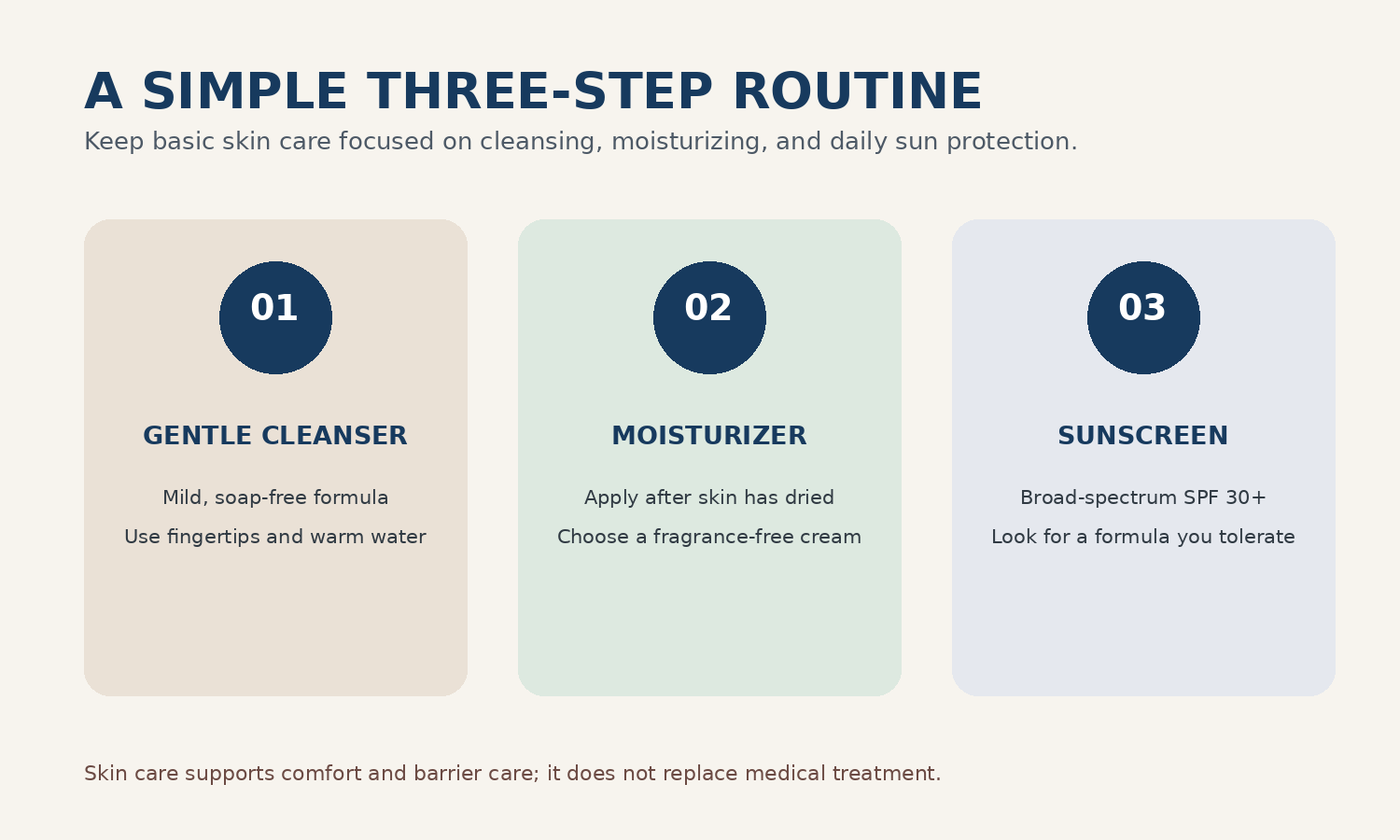
Korean skincare for rosacea does not need to mean a ten-step routine. For basic skin care, start with three steps: a mild cleanser, a moisturizer that supports the skin barrier, and a broad-spectrum sunscreen. Prescription treatment is separate and should be used as directed by your health care provider.
Skin care cannot cure rosacea. What a gentle routine may do is reduce avoidable irritation, support comfort, and work alongside a medical treatment plan.
Why rosacea-prone skin reacts easily
Rosacea is a long-term inflammatory condition that commonly affects the face. Many people experience persistent color changes, flushing, burning, stinging, bumps, visible blood vessels, or eye irritation. Symptoms and triggers vary from person to person.
Research has also found impaired barrier function in rosacea-affected facial skin. In practical terms, this can make products that feel comfortable to someone else sting or burn on rosacea-prone skin. In a National Rosacea Society survey of 1,066 patients, 41% reported certain skin care products as triggers and 27% reported certain cosmetics. Sun exposure was the most frequently reported trigger at 81%. These are patient-reported survey results, not predictions of how every person will react.
What a routine can and cannot do
There is currently no cure for rosacea. The American Academy of Dermatology and the National Institute of Arthritis and Musculoskeletal and Skin Diseases describe treatment as a combination of rosacea-friendly skin care, trigger management, and medical treatment selected for the person’s symptoms.
A moisturizer or barrier-repair cream may also improve comfort and support the results of prescribed treatment. The goal of this guide is therefore barrier care and lower irritation, not diagnosis or treatment.
The three-step foundation
Cleanse gently. Choose a mild, soap-free cleanser. Apply it with your fingertips, rinse with warm water, and pat your face dry with a clean soft towel. Avoid washcloths, cleansing brushes, scrubs, rubbing, and facial massage. The AAD also advises people with rosacea to stop exfoliating when it irritates their skin.
Moisturize after your skin has dried. The AAD notes that applying moisturizer to dry skin is less likely to burn or sting. If you use a prescribed topical medication, follow your clinician’s instructions about order and timing. A fragrance-free cream made for sensitive skin may be a useful starting point, but the label alone cannot guarantee tolerance.
Use sunscreen every morning. Look for broad-spectrum SPF 30 or higher and water resistance. If sunscreen tends to irritate your skin, the AAD suggests looking for zinc oxide, titanium dioxide, or both, as well as a fragrance-free formula. Regardless of filter type, the useful sunscreen is one you can apply consistently without irritation.
Read a Korean product label without guessing
Start with fragrance. Choose fragrance-free rather than unscented, because an unscented product may still contain ingredients used to mask an odor. Essential oils and some botanical ingredients may also contain fragrance-related components.
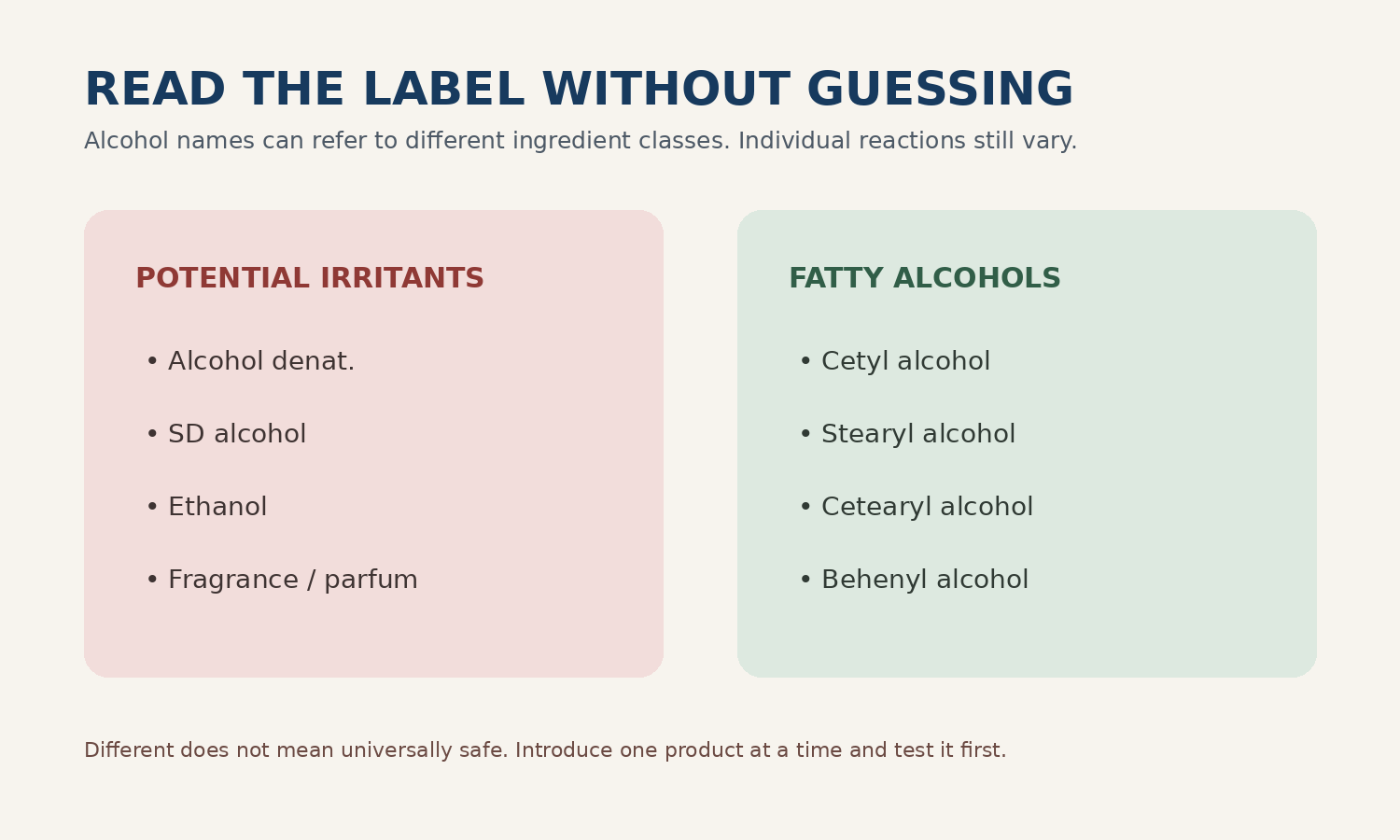
Next, look at alcohol names carefully. National Rosacea Society surveys have identified alcohol as a commonly reported irritant, but the survey does not distinguish every type. Alcohol denat., SD alcohol, and ethanol are different from fatty alcohols such as cetyl, stearyl, cetearyl, and behenyl alcohol. Different does not mean universally safe. A name or position on an ingredient list cannot predict every individual reaction.
The same NRS material lists witch hazel, fragrance, menthol, peppermint, and eucalyptus oil among reported irritants. The AAD also recommends avoiding camphor, glycolic acid, lactic acid, sodium lauryl sulfate, and urea when choosing rosacea-friendly products. These lists are screening tools, not a diagnosis of which ingredient caused a specific reaction.
Barrier-focused ingredients to consider
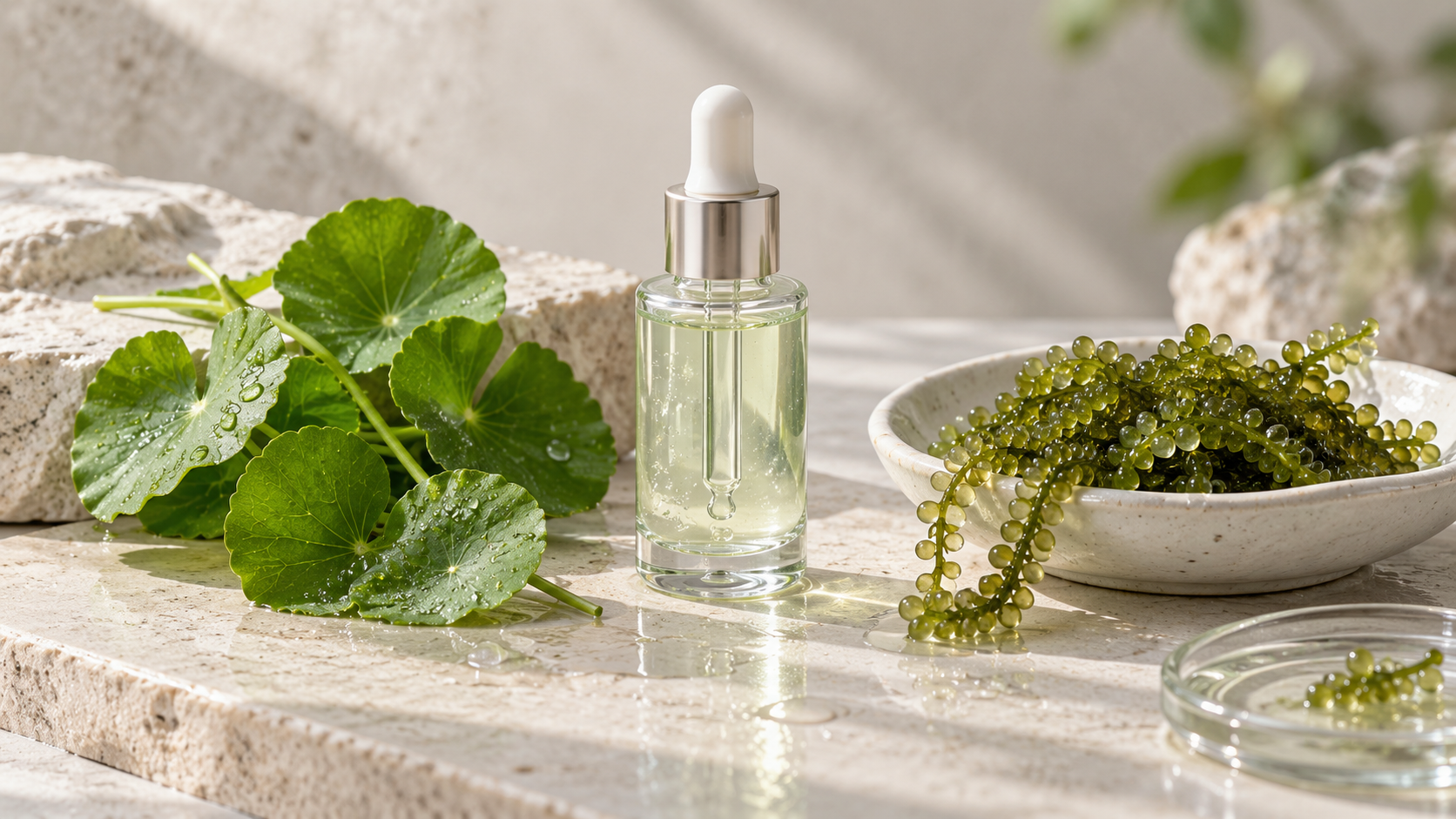
Ceramides, glycerin, hyaluronic acid, squalane, panthenol, and Centella asiatica are commonly found in hydrating or barrier-focused formulas. Ceramides are skin lipids used in moisturizers. Glycerin and hyaluronic acid are humectants. Squalane is an emollient. Panthenol is used in moisturizing formulas, while Centella asiatica and madecassoside often appear in products marketed for calming care.
Their presence does not make a product suitable for everyone with rosacea. Formula, concentration, accompanying ingredients, and individual triggers all matter.
A 2025 observational study evaluated one cream containing Centella asiatica leaf extract, ceramide NP, and panthenol in 88 Chinese women with sensitive skin. It did not study diagnosed rosacea, had no control group, and cannot show which ingredient produced the reported changes. The study was funded by Galderma. It can support further research on a specific sensitive-skin formula, but it should not be treated as proof that these ingredients treat rosacea.
Add one product at a time and test it first
When several products are introduced at once, it becomes difficult to identify the cause of a reaction. Keep the basic routine stable and add only one new product at a time.
For an initial home test, the AAD recommends applying the product to a quarter-sized area on the underside of the arm or inside the elbow twice daily for seven to ten days. Use it for the same amount of time you normally would. For a rinse-off cleanser, leave it on for about five minutes or for the time stated in the directions.
Passing an arm test does not guarantee that rosacea-prone facial skin will tolerate the product. Before using it across your face, try a small amount on a peripheral area such as the jawline or neck and wait to see how your skin responds. If a reaction develops, wash the product off gently and stop using it. Contact a dermatologist if the reaction is severe or does not settle.
A short diary of products, activities, and symptoms can help reveal personal patterns. What triggers one person may not trigger another.
When to see a dermatologist
See a board-certified dermatologist when redness or other symptoms persist, worsen, or are difficult to identify. Rosacea can resemble acne, eczema, seborrheic dermatitis, and other conditions, so an accurate diagnosis matters.
Eye symptoms need particular attention. NIAMS advises seeing a health care provider for sore, red, itchy, watery, dry, or gritty eyes because untreated ocular rosacea can cause eye damage and vision loss.
If you already use prescribed treatment, continue using it as directed. Contact your clinician if you have questions, new symptoms, or a possible reaction. A gentle routine should support medical care, not replace it.
Frequently asked questions
Can Korean skincare cure rosacea?No. Skin care cannot cure rosacea. A gentle routine may reduce irritation and support comfort alongside an individualized treatment plan.
Is a ten-step routine bad for rosacea?The number itself is not a medical rule. However, each additional product creates another possible source of irritation. The National Rosacea Society recommends using as few products as possible.
Is Centella asiatica safe for everyone with rosacea?No ingredient is universally safe. Centella is common in calming formulas, but direct evidence in diagnosed rosacea is limited and individual reactions vary.
Should I use exfoliating acids, retinol, or high-strength vitamin C?These ingredients are not required for a basic rosacea-friendly routine and may irritate sensitive skin. The AAD specifically lists glycolic and lactic acid among ingredients to avoid. Ask a dermatologist before adding stronger active products, especially during a flare.
Mineral or chemical sunscreen?If sunscreen irritates your skin, the AAD suggests looking for zinc oxide, titanium dioxide, or both. Whatever the filter type, choose a fragrance-free, broad-spectrum SPF 30 or higher product that your skin tolerates.
A calm routine is usually a small one. Korean skin care can offer useful cleanser, moisturizer, and sunscreen options, but the country of origin does not determine whether a formula is right for rosacea. Read the full label, introduce one product at a time, and let a dermatologist handle symptoms that skin care cannot resolve.
Image credits: K Gallery original images and graphics.