What is PDRN skincare? Learn how topical products differ from clinic injections, what current research can and cannot show, and how to read a PDRN label before you buy.
PDRN skincare uses polydeoxyribonucleotide, a DNA-derived ingredient found in some serums, creams, masks and eye products. Scientific literature commonly describes classic PDRN as a mixture of DNA fragments in a molecular-weight range of about 50 to 1,500 kilodaltons, although naming across PDRN and PN products is not fully standardized. In a cosmetic, the whole formula may help skin feel hydrated and comfortable and look smoother or more supple. That is not the same as proving that a bottle produces the effects reported for an injection.
The most useful way to understand the trend is to separate the ingredient name, the source, the finished formula and the type of evidence behind each claim.
What PDRN actually is
The name stands for polydeoxyribonucleotide. PDRN is made of purified DNA fragments rather than whole, functioning DNA. Traditional pharmaceutical literature describes PDRN derived primarily from rainbow trout or chum salmon DNA through controlled purification and sterilization processes.
Newer raw materials are also being studied. In 2025, Amorepacific reported research on a PDRN material derived from the microalga Chlorella protothecoides. That research supports the existence of a non-animal source, but it does not prove that every product marketed as plant, vegan or non-animal PDRN is chemically identical to fish-derived PDRN or performs the same way. Each raw material and finished formula needs its own evidence.
Why PDRN became a K-Beauty topic
PDRN was already familiar in Korean pharmaceutical, medical-device and aesthetic settings before it became a visible cosmetic marketing term. Korean beauty brands then introduced the term across serums, ampoules, creams, masks and eye products, helping international shoppers encounter it outside clinics.
You may also see PDRN mentioned beside PN, or polynucleotide. The names have often been used inconsistently. A 2025 narrative review proposed using PDRN for DNA-derived polymers below 1,500 kilodaltons and PN for longer polymers, but that cutoff is a proposed nomenclature rather than a universally enforced labeling rule. The two terms should not be treated as automatically interchangeable.
Topical skincare and injections are not equivalent
Product pages often move too quickly between cosmetic skincare and in-office procedures. The distinction matters for four reasons:
Delivery: an injection bypasses the outer barrier, while a topical formula must interact with or cross it.
Concentration and formulation: injectable and cosmetic products are prepared for different uses and cannot be compared by name alone.
Depth: placement through a needle is different from passive application on the skin.
Regulation: an in-office procedure is not the same product category as an over-the-counter cosmetic, and approval status varies by market.
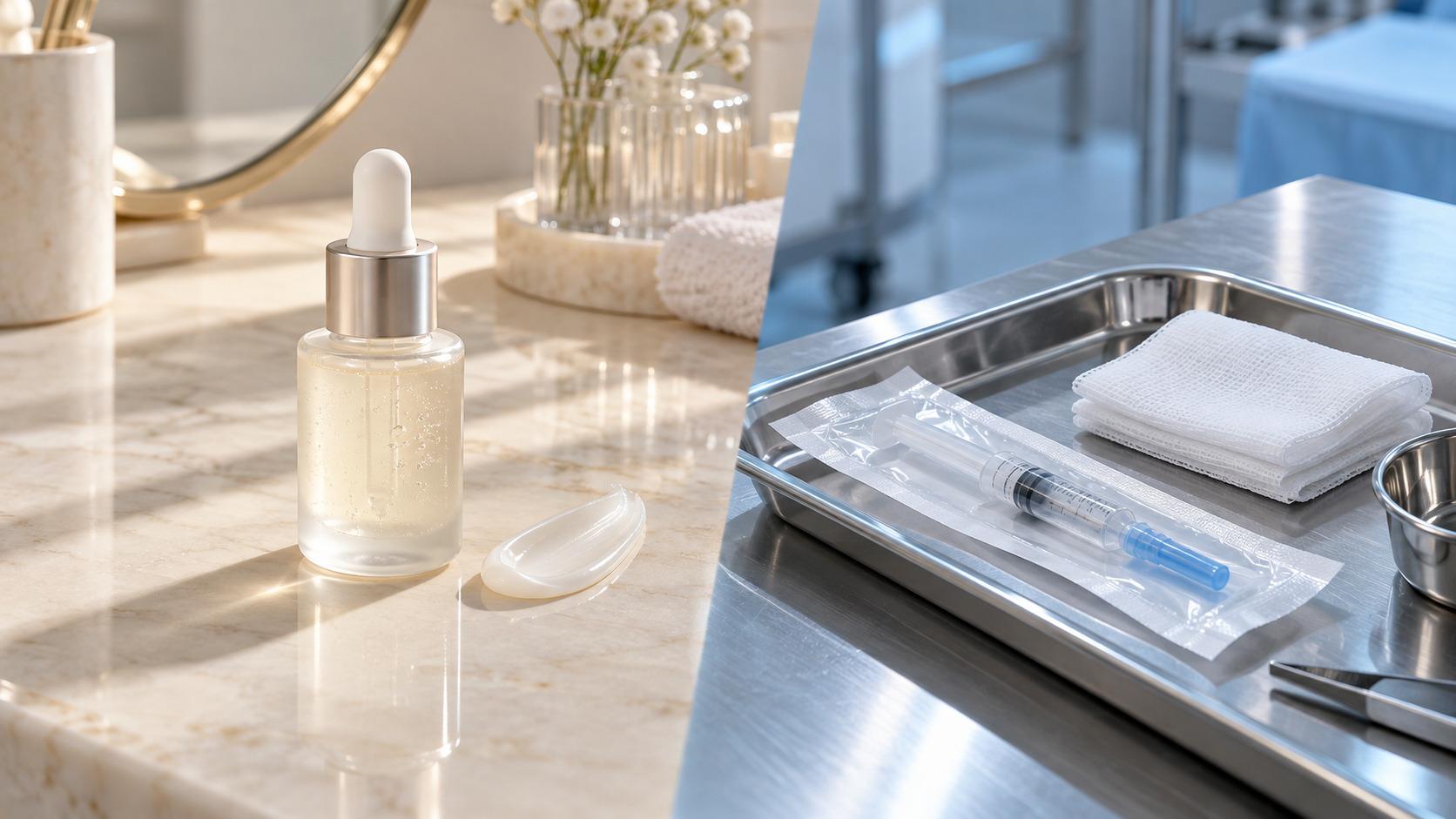
Because these conditions differ, injection studies cannot establish what an over-the-counter serum or cream will do. Regulatory status also varies by country and product. In the United States, a cosmetic label is not evidence that the same ingredient or product is approved for injection.
What topical research shows so far
Research on topical PDRN is emerging, but it remains product-specific. Molecular weight, concentration, delivery system and vehicle can all affect whether a material reaches relevant skin layers and how the finished product performs.
A 2026 PLOS One study tested one water-in-silicone eye cream containing 0.1% PDRN-850K against an otherwise matched eye cream containing 0.1% retinol. Thirty-one healthy Chinese women aged 35 to 55 with self-reported sensitive skin applied the products to opposite sides of the eye area twice daily for 28 days. The design offers early evidence for that formulation under those conditions, not for every PDRN cosmetic.
The authors noted that 28 days is short for mature dermal remodeling and that some early changes could partly reflect temporary hydration or plumping. The study also included laboratory, reconstructed-skin and ex vivo work that should not be confused with long-term consumer outcomes. The authors declared no conflicts of interest, although several authors listed affiliations with biotechnology or company research organizations. Larger independent studies across different products and populations are still needed.
For shoppers, the defensible expectation is cosmetic: a formula may support a hydrated, comfortable feel and a smoother or more supple appearance. Claims that a topical cosmetic regenerates tissue, heals wounds, removes scars or reproduces an injectable procedure go beyond what this evidence establishes.
How to read a PDRN product label
PDRN on the front of a package is a marketing term, not necessarily the ingredient name used in the full list. Depending on the material, the list may use names such as Sodium DNA, Hydrolyzed DNA or Hydrolyzed Sodium DNA. Korea's cosmetic ingredient dictionary lists these as skin-conditioning ingredients, but the dictionary also warns that listing a standardized name does not by itself establish that every raw material is permitted or effective in every finished product.
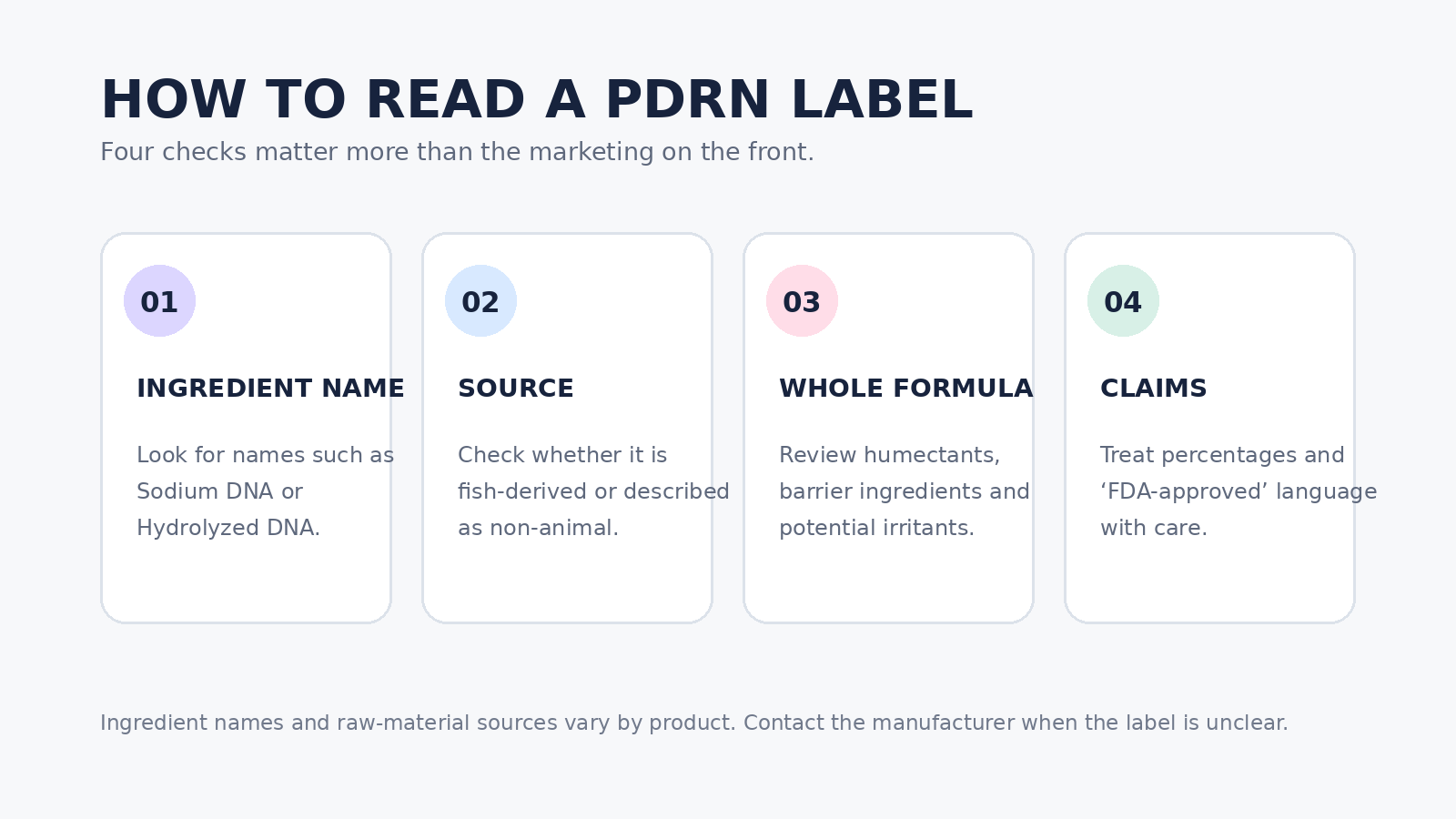
Next, verify the source. Do not assume that every PDRN product is salmon-derived, or that every newer product is vegan. If fish-derived ingredients matter to you, check the manufacturer's raw-material statement and ask the brand when the origin is unclear.
Then read the whole formula. Glycerin, hyaluronic acid, ceramides, panthenol and other supporting ingredients may contribute substantially to hydration and skin feel. Fragrance, exfoliating acids or other ingredients may also affect whether the product suits your skin. A disclosed PDRN percentage can be useful, but a larger number does not prove a better result without information about fragment size, purity, delivery and the vehicle.
Treat FDA-approved language carefully. The FDA states that cosmetic products and ingredients, other than color additives, generally do not require premarket approval. Companies remain responsible for safety and labeling, and the FDA can act against products that violate the law. An FDA registration or a cosmetic being sold in the United States is not the same as FDA approval of its effectiveness.
How to add a PDRN cosmetic to your routine
Follow the individual product directions. In a simple routine, cleanse first, apply a serum or ampoule before a thicker moisturizer, and use broad-spectrum sunscreen in the morning. A PDRN cream can take the moisturizer step if its formula is moisturizing enough for your skin.
Add only one new product at a time. The American Academy of Dermatology recommends testing a product on a quarter-sized area such as the underside of the arm or the bend of the elbow twice daily for seven to 10 days, using it for the same amount of time you normally would. Stop if persistent redness, itching, swelling or stinging develops. Seek medical advice for a severe reaction or for an ongoing skin condition.
There is no need to layer a PDRN serum, cream and mask together. PDRN is optional and does not replace a suitable cleanser, moisturizer, sunscreen, prescription treatment or professional care. The useful question is not only whether a product says PDRN, but what is actually in the formula and what evidence supports that specific product.
Frequently asked questions
Is PDRN skincare the same as a PDRN injection?
No. A topical cosmetic is applied to the skin and must work within the limits of the skin barrier and its vehicle. An injection is an in-office procedure with different delivery, depth, dosing and regulatory considerations. Evidence from one cannot be transferred automatically to the other.
Is all PDRN made from salmon?
No. Salmon and trout are traditional sources, while microalgal and other non-animal materials are being studied and marketed. Check the stated source for the specific product rather than assuming.
Is PDRN skincare FDA-approved?
Cosmetics and cosmetic ingredients, other than color additives, generally do not receive FDA approval before sale in the United States. A seller should be able to explain exactly what any FDA-related claim means.
Is PDRN suitable for sensitive skin?
No ingredient is suitable for everyone. The 2026 eye-cream study involved volunteers with self-reported sensitive skin, but it tested one formula and does not prove that all PDRN products are safe for sensitive skin. Patch test the finished product and stop if irritation persists.
Do I need PDRN in my routine?
No. It is an optional cosmetic ingredient. A gentle cleanser, an appropriate moisturizer and daily sunscreen remain more fundamental than adding a trend ingredient.
Image credits: K Gallery original AI-generated images and original graphic.